
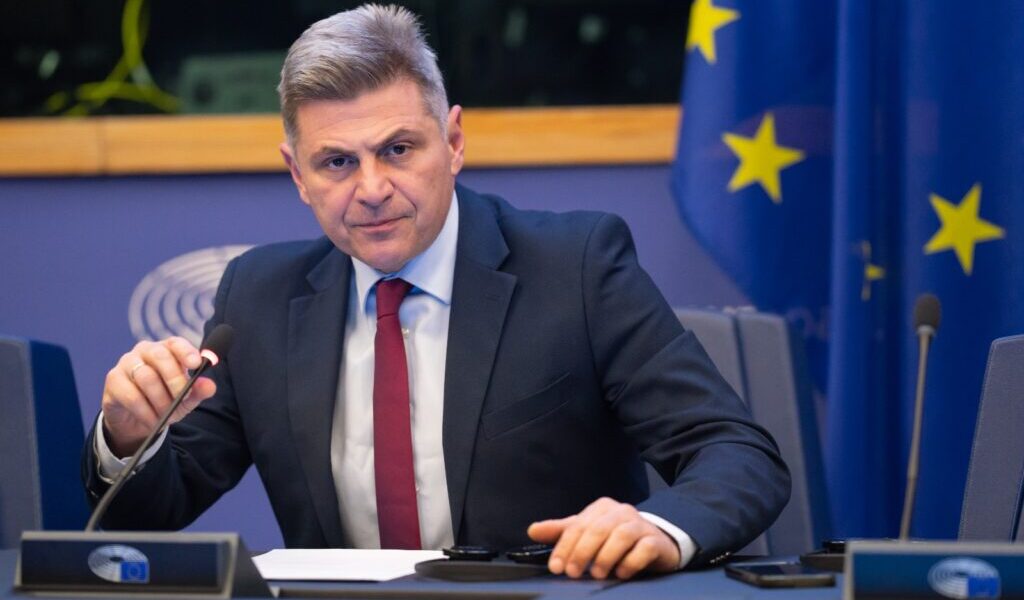
Nikolas Farantouris is a SYRIZA/the Left MEP, a Member of the European Parliament's Committee on Security and Defense, and a Professor of European Law at the University of Piraeus, holding the Jean Monnet Chair.
The Inter-Parliamentary Conference for the Common Foreign and Security Policy and the Common Security and Defence Policy, in which I participated as a member of the European Parliament's Security & Defense Committee, concluded last week in Warsaw.
Turkey, despite the internal turmoil with the imprisonment of Istanbul Mayor Ekrem Imamoglu, had secured yet another major presence in the discussions on European security and defense by receiving yet another invitation to the negotiating tables, and indeed with a large delegation led by Hulusi Akar, Chairman of the National Defense Committee of the Turkish Grand National Assembly and former Minister of Defense of Turkey.
My position as a member of the Security and Defense Committee in the work of the conference was clear:
A common security and defense policy is the natural and logical continuation of the European unification project. Together with a common foreign policy, it is the next step in Europe's political integration and strategic autonomy.
Moreover, if we want to safeguard our territorial integrity and national sovereignty, we must say yes to policies that declare the EU's readiness to act en bloc.
However, it is important to ensure, above all, absolutely and unconditionally, the protection and guarantee of the external borders of the Union. That is, of the Member States. The territorial integrity of the Member States cannot be conditional.
For this reason, Europe should proceed, in addition to financial tools, with specific institutional steps that include:
(a) The collective guarantee of the Union's external borders. Today, the EU "protects" but does not "guarantee" the external borders of the 27 Member States.
(b) The adoption of specific operational tools and arrangements (modalities) for the implementation of the "mutual assistance clause" (based on Article 42, paragraph 7 of the Treaty on EU) for the collective guarantee and protection of every inch of the territory of the Member States.
On the other hand, the European Union cannot proceed with any cooperation on its Defence and Security with a country like Turkey that does not respect common values, the borders of the Member States, democracy, the rule of law, human rights and international treaties and does not recognise the international Law of the Sea. As long as Turkey continues to threaten the security of EU Member States with occupation troops and casus belli, it cannot be an integral part of the common defence policy.
Regarding the cost: It is crucial that the new European security and defense architecture does not lead to cuts or transfers of resources from social and regional cohesion.
The consequences of the resulting imbalance would be disastrous: aggravation of social and regional inequalities, marginalization, the rise of the far right, and ultimately the dissolution of the unifying project and of the Union itself. But also in purely geostrategic-defense terms, from Thucydides and Sun Tzu to the lessons of modern history, structural deterrence is a function of internal cohesion.
Yes, then, to a common European security and defense policy. Not without guarantees of the national sovereignty and territorial integrity of the Member States or at the expense of the social and regional cohesion of the Union.
READ MORE: Are Greece and Israel heading towards a “combat” relationship?
Stay updated with the latest news from Greece and around the world on greekcitytimes.com.
Contact our newsroom to share your updates, stories, photos, or videos. Follow GCT on Google News and Apple News.

