
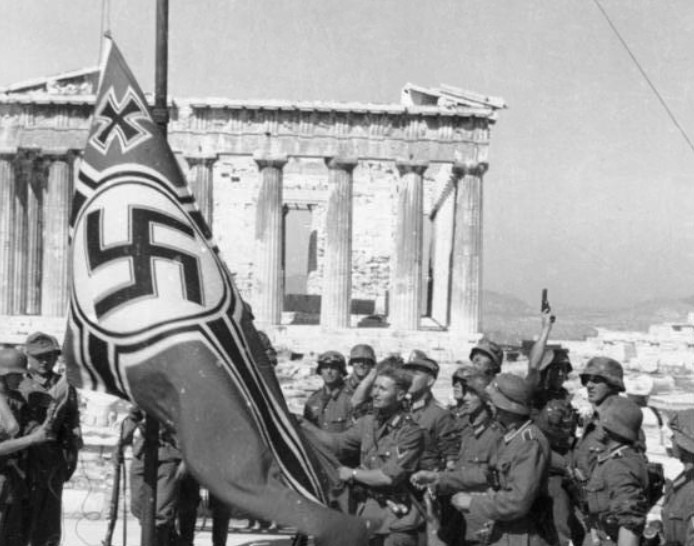
On the night of May 30, 1941, under the shadow of Nazi occupation, two young Greek resistance fighters, Manolis Glezos and Lakis (Apostolos) Santas, both 19, delivered a powerful symbolic blow to the German occupiers by removing the Nazi swastika from the Acropolis in Athens.
As dawn broke on May 31, 1941, Athenians awoke to an astonishing sight: the swastika, a symbol of oppression and violence that had flown over the sacred rock since the German invasion, was gone. The news spread like wildfire through the capital, lifting the spirits of a people suffering under occupation. The identities of the daring perpetrators remained a mystery, known only as whispers of hope among the oppressed.

A Bold Plan Under the Nazis’ Noses
Glezos and Santas, bound by close friendship and a shared resolve to resist, devised their plan after spotting the swastika waving defiantly over the Acropolis from the Zappeion. Determined to strike at the heart of Nazi propaganda, they meticulously prepared by studying a map of the Acropolis at the Benaki Library. They discovered a hidden passage on the northwest side—a narrow crevice leading to an opening near the Erechtheion, covered by wooden planks and equipped with old beams from past construction work.
On the night of the operation, starting around 9 p.m. from Eleftherias Square, the two set out unarmed, save for a single knife carried by Santas. Curfew restrictions meant they risked capture, but they pressed on. Upon reaching the Acropolis, they heard German guards carousing with women at a nearby post, leaving the flagpole unguarded. Slipping through the crevice after moving the planks aside, they climbed for about 20 minutes to reach the rock.

A Struggle Against Time and Wire
The task was far from simple. The swastika was secured to a tall pole with wire ropes and knots, fastened tightly to the ground like a maypole. For nearly an hour, Glezos and Santas struggled to free it, throwing pebbles toward the nearby guard post to ensure it remained empty. When their attempts to climb the slick pole failed, they resorted to brute force, using Santas’ knife and their hands to cut through the wires. Finally, the massive flag—measuring 3-4 metres long and 2 metres wide—fell, briefly enveloping them.
The young men cut two pieces from the swastika’s black cross, each keeping a fragment as a memento, before bundling the rest and discarding it in a nearby ditch, covering it with dirt and stones. By 12:30 a.m., their mission was complete. They escaped through a small gate, crawling past wire fences and descending the Plaka steps to safety.
A Narrow Escape and a City Inspired
On their way back through Athens, the pair narrowly avoided disaster. Near Mitropoleos Square, a Greek policeman spotted them, shining his flashlight and shouting, “Halt!” Thinking quickly, they claimed to be students delayed at a friend’s house. The officer let them pass, warning them to avoid German patrols. Later, they learned he joined the resistance and died fighting.
The next morning, Athenians climbed rooftops to gaze at the Acropolis, buzzing with rumors—some believed the Germans were retreating, others that the British had landed. Glezos and Santas, watching silently, felt a surge of pride. To protect the Acropolis Museum guards from blame, they deliberately left their fingerprints on the pole, ensuring the Germans’ investigation would clear the innocent.

German Fury and Lasting Legacy
Two days later, the German commander issued a furious announcement in the censored press: “On the night of May 30, the German war flag flying over the Acropolis was stolen by unknown perpetrators. Strict investigations are underway. The guilty and their accomplices will face the death penalty.” Fortunately, Glezos and Santas remained undetected, their identities revealed only decades later.
In 1976, Santas recounted the feat to journalists, as reported by To Vima. He and Glezos described their meticulous planning, their climb, and the nerve-wracking moments of cutting the flag free. Glezos emphasised their intent to remain anonymous, driven not by personal gain but by a duty to show that Greek resistance endured, even as Crete fell and organized fighting ceased.
Heroes of Resistance
Glezos and Santas became symbols of Greek defiance. Glezos described Santas as “open, bold, and daring,” while Santas called Glezos “a remarkable, courageous fighter and scholar.” Their act, timed to coincide with the German announcement of Crete’s capture, was a beacon of hope, proving that the Greek spirit could not be subdued.
Yet, Glezos noted in 1976 that the broader Greek resistance, including other heroic acts like those at Ymittos and Kallithea, deserved greater recognition. He lamented the lack of a national day to honor the resistance or memorials for the executed, such as those buried in Athens’ Third Cemetery.
Today, as we mark 84 years since their daring act, the names of Manolis Glezos and Lakis Santas remain etched in Greece’s history, a testament to the courage of ordinary citizens who defied tyranny under the shadow of the Acropolis.
(Source: To Vima)
Stay updated with the latest news from Greece and around the world on greekcitytimes.com.
Contact our newsroom to share your updates, stories, photos, or videos. Follow GCT on Google News and Apple News.
