
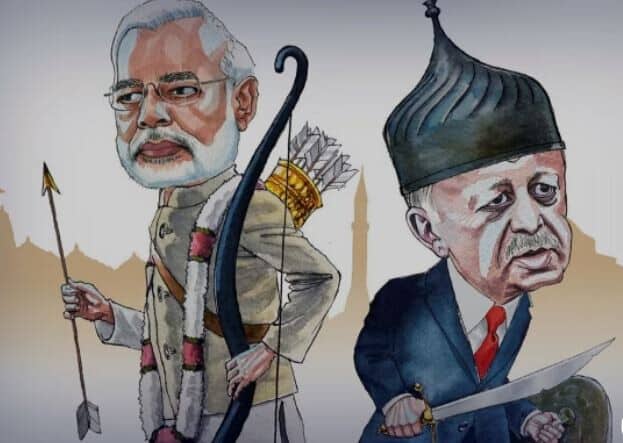
The defense sector of India is back in the spotlight, especially after the escalation of tensions with Turkey.
India’s strategic shift underscores the urgent need to foster domestic technological self-sufficiency, while simultaneously fortifying alliances with countries Ankara views as rivals.
“The recent joint naval exercises with Greece and Cyprus highlight New Delhi’s intent to counter Ankara’s growing involvement in South Asia and its deepening military cooperation with Islamabad and Azerbaijan. At the same time, India is enhancing defence ties with Israel, a long-standing strategic partner, thereby cementing a multi-pronged strategy aimed at building deterrence against hostile regional alliances. The sector is undergoing a structural transformation, driven by rising geopolitical threats, a determined push for self-reliance, expanding export opportunities, and the growing participation of private companies and startups in areas such as aerospace, artificial intelligence, cyber defence, and drone technologies," said Sugandha Sachdeva, Founder-SS WealthStreet.
According to Sachdeva, the Indian defense market is expected to grow sixfold in the next 20 years, exceeding $120 billion, making it one of India’s most promising long-term growth sectors.
Sachdeva also added that exports are set to increase significantly, supported by government policies such as positive indigenisation lists, linked production incentives (PLI), and liberalised foreign direct investment (FDI) rules.
The defense sector is clearly at the heart of the “Atmanirbhar Bharat” (Self-reliant India) agenda, with an emphasis on both strengthening production capabilities and improving international competitiveness.
The Eastern Mediterranean is facing an unprecedented strategic upheaval, as Turkey appears to be moving decisively towards acquiring nuclear weapons.
As it is known, Turkey is strengthening its cooperation with Pakistan - a country with a nuclear arsenal - creating the basis for a strong regional alliance that may reshape the geopolitical landscape in the region.
The escalating military presence, agreements in the defense industry sector, and developments around the Akkuyu nuclear power plant suggest that Turkey is no longer limited to theoretical plans but is moving towards a realistic and worrying nuclear capability.
Amid rising tensions and escalating challenges in the region, Turkish political analyst Yusuf Katipoğlu presented an impressive vision during a press conference.
Responding to a question about the feasibility of concluding a joint defense agreement between Turkey and Arab and Islamic countries, especially Pakistan — a country with nuclear capabilities that would make it a key pillar in any regional alliance — Katipoğlu highlighted the strategic prospects of such cooperation.
As he explained, the Turkish Defense Minister recently visited Pakistan and signed important agreements for the development of Turkish military industrial units. These agreements, according to Katipoğlu, may have strategic and possibly nuclear dimensions.
He emphasized that cooperation between Turkey, Pakistan, and Azerbaijan in the defense industry has evolved from theory to tangible reality. In addition, Ankara, through its defense software, imposes restrictions on countries importing its weapons, preventing them from using them in any attack against Turkey.
Katipoğlu emphasized that cooperation with countries like Pakistan and Russia is not an emergency for Ankara, but rather part of its permanent strategic orientation, which practically implements the principle of "prepare against all the power you can."
At the same time, Turkey announced it has developed a fission bomb called 'Wrath,' which, according to Turkish military experts, could be as powerful as or even surpass a nuclear bomb.
Official Turkish sources confirmed that the bomb has undergone secret tests and that Turkey is at an advanced stage of its development. This is not a passing step, but a clear indication of Turkey’s strategic shift on the nuclear issue.
At the end of his statements, Katipoğlu directly called on Arab and Gulf states to join a strategic alliance with Turkey, emphasizing that the risks concern everyone without exception.
In a warning tone, he stated: "Today it is Qatar, tomorrow it could be Iraq, and the day after tomorrow it is Turkey’s turn… No one is safe from being targeted."
Erdoğan sacrificed the wrong pawn
Turkey-India relations have reached an all-time low, and the underground war between Turkish President Recep Tayyip Erdoğan and Indian Prime Minister Narendra Modi has resulted in the abandonment of huge trade deals worth billions of dollars.
The consequences of this diplomatic bravado are asymmetrical for the entire planet, but primarily concern our country.
As the Eurasian Times reveals, the Turkish government has recently imposed a total ban on the export of military equipment to India, one of the largest arms importers in the world. The move comes months after New Delhi canceled the contract with a Turkish company involved in a shipbuilding project at an Indian shipyard.
It is noted that the Turkish government has not made any official announcements about this. This is because the relevant decision was taken in a closed-door session of the Turkish Parliament.
According to the minutes of the discussion in the Foreign Affairs Committee on July 10, 2024, Mustafa Murat Şeker, vice chairman of the Presidency of Defense Industries (SSB), Turkey’s top arms procurement agency, inadvertently revealed the government’s secret policy regarding India.
India chooses a camp in the Aegean
The move should come as no surprise, as the two countries have been on opposite sides of most global geostrategic issues. As the strategic alliance between Turkey and Pakistan continues to grow, India has taken sides against Turkey on numerous international issues.
After taking sides in the Armenia-Azerbaijan conflict, New Delhi has made it clear that in the Aegean conflict between Turkey and Greece, it is siding with Athens.
In April, New Delhi canceled a contract with a Turkish company involved in a shipbuilding project in India. Then it hosted the Chief of the General Staff of the National Defense of Greece at a fighter base.
Erdoğan raises the Kashmir issue, Modi takes a clear position on Cyprus and the Aegean
The ties between India and Turkey are in the red, as Turkey refused to take a neutral position and strongly supported Pakistani positions on the long-standing issue of the disputed Kashmir. In fact, Turkish President Tayyip Erdoğan has supported Pakistan in all diplomatic forums, from the UN General Assembly, the UN Human Rights Council, to the Financial Action Task Force.
In particular, in his speech at the 74th session of the United Nations General Assembly, he declared: “Kashmir is still under siege and eight million people are trapped in Kashmir.”
“The world must know the suffering of Kashmir,” he emphasized, drawing parallels between Kashmir and Palestine.
In his most pointed statement, which angered New Delhi, Erdoğan called Kashmir “an open-air prison.”
How did Modi respond?
The Indian government responded by inviting the leaders of Armenia, Cyprus, and Greece—all three countries with which Turkey has tensions—to bilateral meetings.
In 2019, Modi was scheduled to visit Turkey and Saudi Arabia. But the visit to Turkey was canceled, and the Prime Minister visited only Saudi Arabia, sending a message to Ankara about India's diplomatic preferences.
Subsequently, in April, India's Hindustan Shipyard Limited (HSL) terminated all agreements with Turkish companies to build the fleet of five support ships for the Indian Navy and decided to proceed with the construction itself with its own resources.
The project, estimated to cost between $1.5 and $2 billion, initially envisaged the transfer of technology from Anadolu Shipyard, part of the Turkish TAIS consortium, with which HSL signed a technical cooperation agreement in 2020.
Ankara's partners in the KAAN project, Pakistan and Azerbaijan
While Turkey has banned exports to India, Ankara is in talks with Islamabad to make it an official partner in the development of the 5th-generation KAAN fighter aircraft. Although it is unclear when Pakistan will join the Turkish fighter jet program, Turkey announced in 2023 that it plans to start negotiations with Pakistan as soon as possible.
“Relatively soon, within this month, we will discuss with our Pakistani counterparts to officially include Pakistan in our national KAAN fighter jet program,” Turkish Deputy Defense Minister Celal Sami Tüfekçi said in Pakistan on August 2, 2023.
The announcement came just days after Azerbaijan also joined the fighter jet project. Turkish Aerospace, which is leading the development of the KAAN, has a close relationship with Pakistan Aeronautical Complex (PAC) Kamra, the state-owned military aircraft company and maintenance, repair, and overhaul house.
Turkey has sided with Azerbaijan in the conflict with Armenia. New Delhi responded by supplying weapons to Armenia.
Earlier this year, as a heated incident emerged between India and the Maldives, a move allegedly orchestrated by China, Turkey provided the island nation with Bayraktar TB2 drones for maritime surveillance. The UAVs were delivered as the Maldives asked Indian defense personnel to leave the island nation, abandoning decades of military and political ties with India.
Turkey is engaged in numerous open fronts worldwide, raising questions about its ability to manage them with diplomatic and military competence without the insoluble contradictions of Turkish foreign policy ultimately turning against Erdoğan and eliminating him.
READ MORE: US-China Trade War: Threat or opportunity for Greece?
Stay updated with the latest news from Greece and around the world on greekcitytimes.com.
Contact our newsroom to share your updates, stories, photos, or videos. Follow GCT on Google News and Apple News.
