
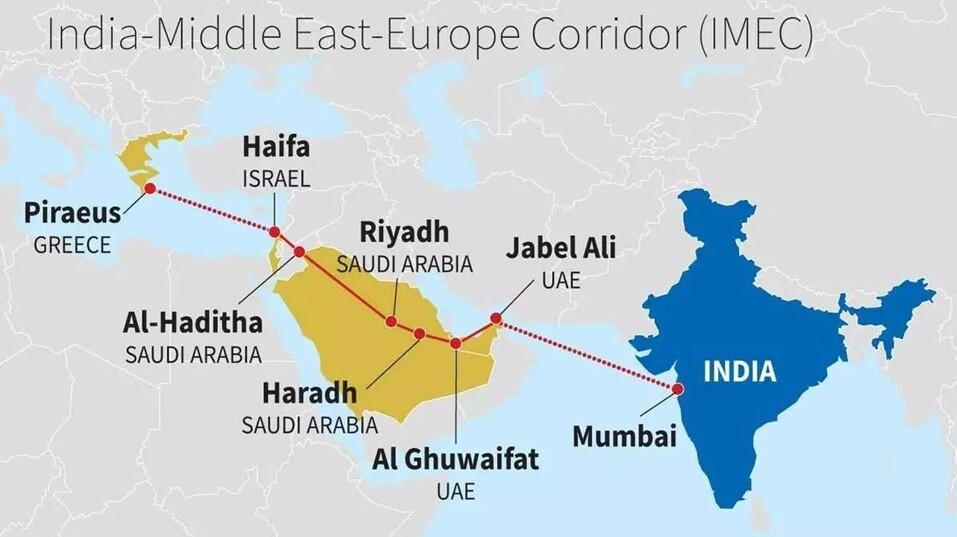
With the entry of foreign investors, the electrical interconnection between Greece and Cyprus is not only strengthened technically and financially but is also upgraded strategically, as it is now directly connected to the under-development India-Middle East-Europe Economic Corridor (IMEC).
The coupling of energy and trade infrastructures creates a new geo-economic landscape, in which the Athens-Nicosia-Tel Aviv triptych can play a decisive role in IMEC.
IMEC is one of the most ambitious and complex connectivity projects announced in recent years, aiming to upgrade trade flows and geo-economic relations between India, the Middle East and Europe. However, its implementation path remains difficult and challenging.
Vasileios Syros, honorary associate at the National Maritime Foundation, the most important Indian think tank in the field of maritime policy, explains to CNN Greece that IMEC "by its nature is an extremely complex interconnectivity project, which requires the coordination of many countries often with divergent interests and geopolitical aspirations."
Despite the strong commitment of India and other stakeholders to the implementation of the corridor, the instability prevailing in the Middle East is a serious obstacle, he underlines. On the other hand, despite the obstacles, he clarifies that "some of the states participating in this project have already made significant moves, which can contribute to the realization of the plan," strengthening the foundations on which the corridor can be built.
"For example, the EU and the Gulf Cooperation Council have resumed negotiations on a Free Trade Agreement. In 2024, the Indo-Mediterranean Initiative was launched. In 2022, India concluded the Comprehensive Economic Partnership Agreement with the United Arab Emirates," he added.
These developments show that despite the difficulties, there is convergence. Mr. Syros points out that in general, there seems to be agreement on the strategy that governs the entire plan. However, according to him, the distance that needs to be covered remains large.
"There is still a long way to go, both literally and figuratively, until the coverage of individual operational needs is ensured," he stressed.
The undertaking requires not only political will but also technical harmonization, investment in infrastructure, stability in relations between countries, and, perhaps above all, a secure regional environment.
IMEC remains a highly strategic project with the potential to reshape trade and geopolitical balances. However, its success will depend on whether the countries involved can overcome geopolitical tensions and coordinate their interests effectively.
The obstacles in IMEC
The implementation of IMEC is stumbling over a series of geopolitical and structural difficulties. Vasileios Syros emphasizes that "the geopolitical turmoil in the Middle East is undoubtedly a serious inhibiting factor for the execution of IMEC."
Instability in the region, he notes, has a direct impact on the progress of such a complex project.
"In contrast to the Belt and Road Initiative, which was launched in 2013 and relies primarily on Chinese funds, IMEC relies on funding from both state and private sources," he explained.
As Mr. Syros pointed out, although there is substantial discussion about the interconnection of the main nodes of the network and especially the ports, "it is not at all clear whether due attention has been paid to the organization of the network inland."
In this context, he added that there are inherent structural problems that will not be easily resolved, especially given that the EU is facing profound political, social, and economic challenges.
The role of Greece
When asked whether Greece's new energy role, combined with American interest in the region, could unlock this specific project, he clarified that "despite the problems that have arisen in US-India relations, American involvement in IMEC remains undiminished, mainly due to its importance as a means of containing China's penetration and influence through the BRI."
According to Mr. Syros, the upgraded energy role that Greece is called upon to assume is not necessarily catalytic for the course of IMEC. However, it may give the project new impetus, especially when the situation in the Middle East normalizes.
At the same time, Mr. Syros adds that Greece's privileged position as a transit station and energy hub will enhance its importance as a strategic partner of India. Particularly at a time when the world's most populous country is seeking to strengthen its footprint in the Mediterranean and gain access to European markets, Greece's geostrategic position is becoming increasingly critical.
He also pointed out that France and Italy, the other two Mediterranean players competing with Greece for benefits from IMEC, have adopted a critical stance towards Israel.
On the other hand, as he underlined, "Greece's close relations with Israel, as well as the development of the Israel-Cyprus-Greece axis in conjunction with the deepening of Greece-India cooperation, will determine the geostrategic advantages that Greece will derive from IMEC."
In short, "with India, it's a win-win," he concluded.
READ MORE: Greece flooded with cheap parcels from China – Market restarts after tariffs.
Stay updated with the latest news from Greece and around the world on greekcitytimes.com.
Contact our newsroom to share your updates, stories, photos, or videos. Follow GCT on Google News and Apple News.
