
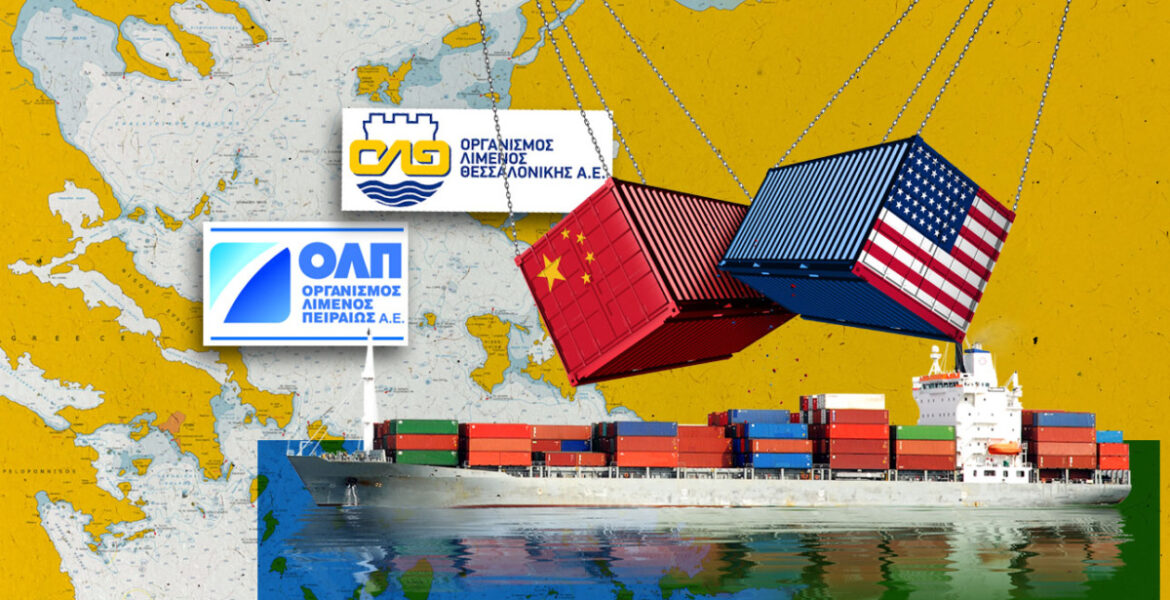
The Trump administration has made no secret of its main geopolitical goal: containing Beijing's influence globally. In this context, the battle for Greek ports will not be limited to Piraeus, as sources with knowledge of the situation note. The control of other critical port facilities in Greece will also be on the table.
A Greek diplomat with long experience in Greek-American relations told the outlet Protagon several weeks before Ambassador Kimberly Guilfoyle arrived in Athens, that "the dossier she will bring with her is much more 'heavy' than some people think. It will concern both the foreign and domestic policy of the country."
The case of the Vertical Gas Corridor, aimed at strengthening Ukraine and, mainly, replacing Russian gas with American liquefied natural gas (LNG), was first on the agenda. However, the issue of control of Greek ports, which was raised immediately afterwards, clearly brings the Sino-American confrontation to the fore, and indeed on Greek soil.
Eleusis as a counterweight to Piraeus
In her first television interview on ANT1 after her arrival, Ms. Guilfoyle described the transfer of control of the port of Piraeus to China's COSCO as unfortunate, but immediately added that there are ways to circumvent Chinese influence.
Her statement provoked a harsh response from the Chinese embassy, which accused her of engaging in hegemonic practices. A few days later, it was announced that the US will help the transformation of the port of Eleusis into a modern multi-purpose port – for both commercial and military purposes, following the model of Alexandroupolis – by offering ONEX (which has already taken over the Eleusis Shipyards and has also received $125 million in financing from the American development bank DFC) the opportunity to expand its activities.
The transfer of Piraeus to the control of COSCO did not happen overnight. Nor are the reactions to this development anything new. It is also well known that no Western (especially European) company invested in one of the largest European ports when it was on the privatization list under the suffocating pressure of the troika memorandum, especially from Germany.
Of course, Piraeus is not the only "gem" the company, the fifth-largest port manager in the world, has acquired. In one of its latest moves in 2022, it acquired a 24.9% stake in the Tollerort terminal in the port of Hamburg, which, together with Rotterdam and Antwerp, constitutes the three largest European ports.
However, COSCO's entry into Piraeus began before the Troika, when, in 2008, during the prime ministership of Kostas Karamanlis, it received a 35-year contract to use two piers. Subsequently, during the economic crisis, COSCO acquired 51% of the shares of the Piraeus Port Authority (PPA) and, in 2021, increased its stake to 67%!
The Chinese have always seen Piraeus as a key link in the "Belt and Road Initiative" (BRI), which they promoted in conjunction with the - now rather frozen - "17+1" initiative that aimed to expand Chinese influence in Central and Eastern Europe and to which Greece joined under the SYRIZA government. Today, however, Beijing has focused its attention on two countries in this region: Serbia and Hungary.
The distant Colby and the Sino-American rivalry
The Trump administration has made no secret of its main geopolitical goal: containing Beijing's influence on a global scale. The shaping of American policy on the issue of China (and not only) passes through the office of Elbridge Colby every day. The author of the book "The Strategy of Denial" is currently the Undersecretary of Defense (or War, as the ministry was recently renamed), with responsibility for defense planning and writing the long-awaited National Defense Strategy of the United States.
A person who diligently avoids publicity, Colby, co-founder in 2019 with Wes Mitchell (Deputy Secretary of State in the first Trump administration), the think tank “Marathon Initiative”, describes himself as a “conservative realist” and insists that Washington must focus its strategy on containing Beijing.
In a move that went unnoticed by many in Greece, Deputy Foreign Minister Alexandra Papadopoulou met with Elbridge Colby in his office on September 20, and, in fact, the American Deputy Secretary made this contact public in X, an element that undoubtedly proves that the channels between Athens and Washington are functioning quite well.
The battle for Greek ports will not be limited to Piraeus, as sources familiar with the situation note. After all, the No. 2 of the American embassy, Josh Hack, has extensive experience in Chinese and Asian affairs, so he knows the stakes very well.
On the table will be, in one way or another, the control of other critical port facilities in Greece, such as those of Thessaloniki and Volos. And all this for two reasons.
The first reason is that the Eastern Mediterranean region has great geopolitical and geostrategic importance as a transit area for trade, energy, and defense corridors, at a time when the sea route through Suez is not considered safe. In this context, the success of the ambitious India-Middle East-Europe Corridor (IMEC) plan may not be immediate, but the major international players are planning for the long term. Trump's intention to impose peace in the Middle East is linked to these plans.
Greece wants to be the European end of this corridor, but it has a competitor: Italy.
China’s presence in Piraeus is disorienting because control of the ports is combined with control of supply chains and information. And many believe that Rome will claim the role of ending IMEC for it.
The second reason is that Greece has a significant energy and military presence (beyond the Souda airbase) that signals to the United States and the West more broadly. In the energy sector, after everything that has happened in recent weeks regarding the Vertical Gas Corridor, Volodymyr Zelensky's visit to Athens and the supply of Ukraine and the wider Central and Eastern Europe with American LNG (and in the future possibly also with gas from the Greek seas due to the activities of American companies), it becomes clear that the existence of significant port facilities under direct or indirect American control is becoming critical.
And if the control of Alexandroupolis is on the right track, in the eyes of the Americans, the same is probably not happening with Thessaloniki and Volos, as the developments of recent months demonstrate.
The game with OLTH and OLB
Regarding Elefsina, it is noted that Motor Oil plans to build a new floating regasification terminal (FSRU) in the area. Following developments regarding the port of Elefsina and ONEX, a plan expected to be promoted soon with legislative regulation, the solution has been found.
At the same time, however, the possibility of creating a second FSRU in Northern Greece has already been discussed, with its location currently unknown, while another FSRU is being prepared in the Volos area. These developments also affect developments at the Thessaloniki Port Authority (THA) and the Volos Port Authority (VPO).
It should not be overlooked that both Volos and Thessaloniki are of great importance from a military perspective due to the American presence. What happened with the Port of Alexandroupolis shows many similarities to what happened a few years ago with the Port Authority of Alexandroupolis, when public-interest considerations led to the cancellation of the tender. The same invocation of public-interest reasons was made in the case of the Port of Alexandroupolis.
Today, Alexandroupolis is part of the Greece-US Mutual Defense Cooperation Agreement (MDCA). As for Thessaloniki, its military importance to NATO and European military forces is crucial for docking, exercises, and resupply, while the European Union's plans to create military mobility corridors will further enhance Northern Greece's strategic significance.
In fact, recently, information has been circulating that the BlackRock and Mediterranean Shipping Co. (MSC) consortium is considering a move for the Port of Alexandroupolis. The consortium in question recently made a strategic move that includes the purchase of a majority stake in ports managed by the Chinese CK Hutchison Holdings (headquartered in Hong Kong), including those in Panama and other key locations worldwide.
READ MORE: Trump to Designate Muslim Brotherhood as Foreign Terrorist Group.
Stay updated with the latest news from Greece and around the world on greekcitytimes.com.
Contact our newsroom to share your updates, stories, photos, or videos. Follow GCT on Google News and Apple News.
