
An international oceanographic research mission has begun work in the Santorini region, aiming to strengthen monitoring systems and improve early warning capabilities for seismic and volcanic activity in one of the Mediterranean’s most active volcanic zones.
Led by the GEOMAR Helmholtz Centre for Ocean Research Kiel, with the participation of the National and Kapodistrian University of Athens (NKUA), the mission seeks to deepen scientific understanding of the Santorini–Kolumbo volcanic system and to enable the real-time transmission of critical data from the seafloor.
The oceanographic expedition M215 departed from Heraklion, Crete, on Monday and is now operating in the waters around Santorini. Just seven kilometres northeast of the island lies the active submarine volcano Kolumbo, part of a chain of more than 20 underwater volcanoes that make up the Santorini–Kolumbo volcanic field.
A central focus of the mission is the testing and expansion of innovative monitoring technologies that could significantly enhance early warning systems for earthquakes and volcanic eruptions. These advances aim to detect changes beneath the seafloor before seismic activity becomes noticeable on land.
Santorini entered a period of heightened alert in early 2025, when more than 28,000 seismic events were recorded within a few weeks. As early as December 2024, under the MULTI-MAREX research project, scientists had already begun studying geological processes in the region that can trigger landslides, eruptions and tsunamis. Shortly after, the seismic swarm began, prompting researchers from GEOMAR and NKUA to collect on-site data throughout the crisis.
Data analysis by GEOMAR and Germany’s GFZ Helmholtz Centre for Geosciences indicated that the 2025 seismic swarm was caused by magma movement at significant depth. Through the M215 mission, scientists aim to better understand how volcanic systems respond to such processes and to assess potential future scenarios.
Researchers stress that systematic marine data collection is critical to improving knowledge of regional seismicity and clarifying the links between magmatic processes and active tectonics.
Professor Paraskevi Nomikou of NKUA highlighted the broader social importance of continuous monitoring. Speaking to the Athens–Macedonian News Agency (AMNA), she said that sustained observation of Kolumbo and the surrounding area helps ensure reliable public information while preventing misinformation and unnecessary panic, noting the importance of international scientific cooperation.
Innovative Technologies on the Mediterranean Seafloor
During the mission, scientists will deploy and recover monitoring stations and carry out extensive geophysical surveys. Seismometers placed on the seafloor in December 2024—inside and around the Kolumbo volcano—will be retrieved after having recorded conditions before, during and after the seismic crisis. These instruments are expected to provide valuable insights into dynamic changes within the volcanic system.
Dr Jens Karstens, a marine geophysicist at GEOMAR and co-leader of the expedition, described the situation as scientifically unique. He noted that having measurements from all phases of the crisis allows researchers to directly compare data and repeat experiments, producing conclusions that would otherwise take many years or even decades.
One of the mission’s objectives is to test a new, integrated monitoring system designed to complement existing early warning networks, which currently rely mainly on land-based seismometers and GPS stations.
Professor Heidrun Kopp of GEOMAR, head of the expedition and coordinator of MULTI-MAREX, explained that while land-based systems are highly reliable, the goal is to detect early signals from the seafloor before tremors are felt. She added that close cooperation with Greek authorities aims to improve risk assessment for coastal areas.
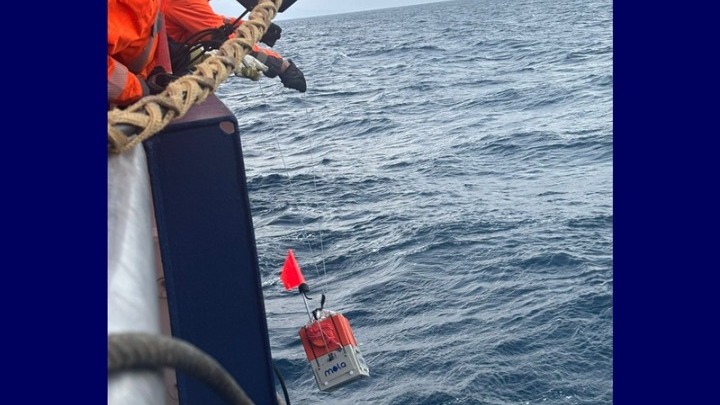
A key role will be played by MOLA (Modular Ocean Lander) units—small autonomous devices that record sound, temperature and carbon dioxide concentrations on the seabed and communicate with each other in near real time. The long-term goal, according to Professor Nomikou, is the real-time transmission of data from the ocean floor.
The mission also involves the Santorini Submarine Volcano Observatory (SANTORY), whose collaboration with MULTI-MAREX enables near real-time monitoring of Kolumbo through direct seafloor data transmission. Autonomous underwater vehicles will map areas with gas emissions, while high-resolution visualisation of the hydrothermal field will help scientists understand changes in seabed morphology and bacterial communities following the seismic crisis.
Researchers will also reuse the MOMO video-mapping system, which allows millimetre-scale mapping of the seabed, and will assess the stability of volcanic slopes in the Santorini–Kolumbo area to determine how they respond to tectonic activity.
Beyond scientific research, the collected data will support educational initiatives for Santorini’s children through dedicated workshops, presenting the island as a living natural laboratory for Earth science, Professor Nomikou said.
MULTI-MAREX is one of four projects under the mareXtreme research mission, coordinated by the German Marine Research Alliance (DAM). The initiative aims to establish a “living laboratory” in the central Mediterranean for studying extreme marine geohazards, including earthquakes, volcanic eruptions and tsunamis.
Stay updated with the latest news from Greece and around the world on greekcitytimes.com.
Contact our newsroom to share your updates, stories, photos, or videos. Follow GCT on Google News and Apple News.
