
A quadrilateral meeting of Energy Ministers from the United States, Israel, Greece, and the Republic of Cyprus is expected to take place in Athens on November 6. The meeting will focus on energy cooperation in the Eastern Mediterranean and the Indo-Mediterranean Economic Corridor (IMEC). The meeting will take place on the sidelines of the Partnership for Transatlantic Energy Cooperation (P-TEC), which will be held at Zappeion on November 6 and 7. Athens is hosting ministers, officials, and leading energy executives from 25 countries at an event expected to highlight Greece’s role as a regional natural gas and LNG hub for Europe.
In the Turkish media, the participation of Cyprus, Greece, Israel, and the USA has sparked discussions about whether the meeting is taking on an anti-Turkish character, as IMEC's planning in several phases appears to bypass Turkey and the pseudo-state.
What is IMEC?
India presented the IMEC corridor at the G20 Summit, aiming to connect the South Asian country with the Middle East and Europe via Israel and Greece. It is offered as a Western—and particularly American—response to the Chinese Belt and Road Initiative.
The collaboration involves, at various levels, the US, India, the UAE, Saudi Arabia, Jordan, Israel, Greece, EU states, and the European Commission.
IMEC can act as a Western counterweight to both China's Belt and Road Initiative and Russian influence in Eurasia.
Objections and the Turkish parameter
According to Turkish analysts, a key issue is whether IMEC can be implemented without Turkey's participation, which controls the mainland and sea passages in the region, as well as critical energy fields through the illegal "Blue Homeland".

Professor of International Relations, Uğur Özgöker, speaking on a Turkish television network, argued that "an attempt to bypass Turkey" and the so-called Turkish Republic of Northern Cyprus, an illegal entity recognized by no other country but Turkey, "is not realistic either economically or strategically," noting that the cost of undersea pipelines in the Eastern Mediterranean that had been considered in the past was estimated at €70-75 billion.
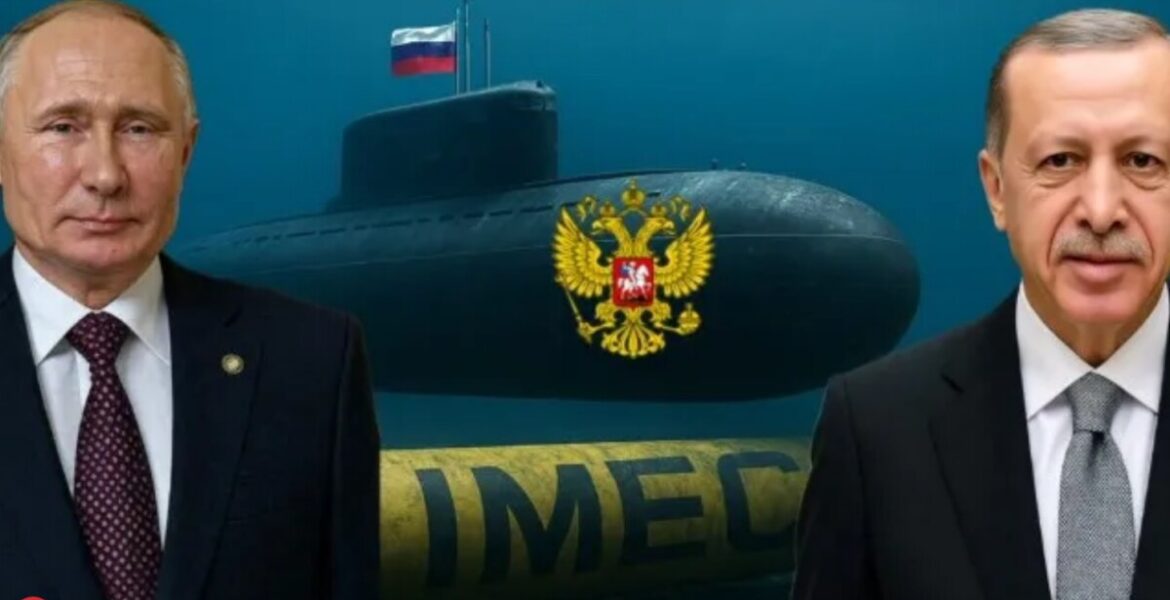
In particular, Professor Özgöker, commenting on the issue of building a pipeline from the Aphrodite field in Egypt, said: "In the event of a geopolitical conflict, a Russian naval force in the Mediterranean or a Russian submarine could hit undersea infrastructure. This makes the pipeline extremely vulnerable and increases the risk for investors."
As he said, transporting natural gas through Cyprus, Crete, and mainland Greece is considered high-risk, while the route through Turkey to Europe is much cheaper and has existing energy infrastructure.
At the same time, he added that major geopolitical players such as Russia would not view positively a new alternative energy route in which they would have no say or influence.
READ MORE: Greece Greenlights €199.4 Arms Package to Ukraine via Czechia, Featuring 60 M110A2 Howitzers.
Stay updated with the latest news from Greece and around the world on greekcitytimes.com.
Contact our newsroom to share your updates, stories, photos, or videos. Follow GCT on Google News and Apple News.
