
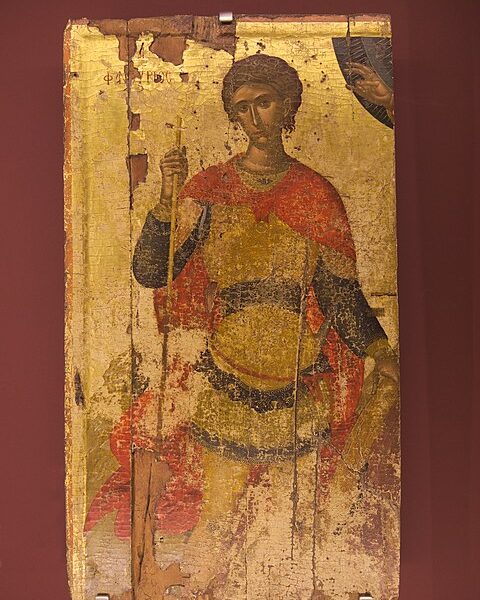
Saint Fanourios is a revered and holy figure among the Christian saints. What sets him apart is that he is not only honored on a single feast day, but the faithful also make use of the renowned "fanouropita" (Fanourios cake) in his name.
Saint Fanourios lived during the Roman era and bravely stood up against the idolatrous world of his time. His unwavering Christian spirit did not allow him to deny his virtuous principles, even in the face of 12 tortures that he endured. His courageous sacrifice serves as a powerful example of perseverance and adherence to the moral values of Christianity. Though we may not face the same physical trials as Roman soldiers or Hagarenes (Muslims), we are still called to confront the more subtle traps of materialism and atheism that seek to overwhelm the Christian way of life.
Like Saint Fanourios, we must learn that the crown of a virtuous life is not easily won, but requires bold action, patience, and perseverance. By imitating his exemplary and blameless life, we too can strive to honor the Christian name we bear, as he so fittingly did.
The Life of Saint Fanourios
Little is known with certainty about the lineage and life of Saint Fanourios, as details about him were lost during turbulent times. The only information we have is the discovery of his icon, which occurred around 1500 AD according to the Synaxarion, or around 1355-1369 AD according to other sources. The icon was found either in Rhodes or Cyprus.
The Discovery of the Icon
During a time when the Hagarenes (Muslims) ruled Rhodes, they decided to rebuild the city walls, which they had previously demolished. The workers were sent outside the southern part of the citadel to gather stones from the partially ruined houses of the inhabitants. In the ruins, they discovered a partially destroyed church, within which was a multitude of icons, their faces and inscriptions having become indistinguishable over time.
However, one icon stood out, unaffected by the passage of time. It depicted a youthful soldier bearing a cross in his left hand and a lit candle in his right. The Metropolitan of Rhodes, Nilus, immediately recognized the icon and clearly read the name "Fanourios" inscribed around it. Moved by the saint's appearance, the Metropolitan saw that the iconographer had also painted 12 depictions of the martyrdom Fanourios had suffered.
The Twelve Tortures of Saint Fanourios
- Fanourios stands boldly before the Roman magistrate, testifying and defending his Christian faith.
- The soldiers strike Fanourios' head and mouth with stones, trying to force him to deny the Lord.
- The enraged soldiers throw Fanourios to the ground and beat him mercilessly with sticks and clubs, seeking to break his steadfast resistance.
- Fanourios is tortured in jail, his naked body torn by sharp metal instruments, yet he endures in silence.
- Fanourios prays in jail, asking God to strengthen him to the end of his tortures.
- Fanourios is brought before the magistrate again, his peaceful expression unflinching despite the tortures and threats.
- The torturers burn Fanourios' naked body with lit torches, but his indomitable will and fortitude for the Lord remains unbroken.
- Fanourios is tied to a crushing press, his bones being broken, yet he suffers without complaint, his face exuding an inexpressible exultation.
- Fanourios is cast into a pit to be prey for wild beasts, but the beasts remain docile, surrounding him like lambs.
- The torturers crush Fanourios under a huge rock, but again they fail to finish him off.
- The torturers urge Fanourios to sacrifice, placing burning coals in his hands, but he passes this test victoriously as a devil in the form of a dragon cries over its failure.
- Fanourios is finally cast into a large furnace, where he prays intently to God without complaint, and thus unwavering, he flew to heaven, full of contentment for all the tortures he had suffered.
The Erection of the Church
After carefully studying the discovered icon, the Metropolitan of Rhodes, Nilus, pronounced Fanourios as one of the Church's most significant great martyrs. He obtained a permit from the ruler of the island to erect a church on the site where the icon was found, outside the city walls. This church survives to this day as a sacred shrine for all Christians.
Miracles of Saint Fanourios
Saint Fanourios worked many miracles for the pious who called upon his name. One notable miracle involved the freeing of three Cretan priests who had been captured by Hagarene pirates and sold into slavery in Rhodes. After venerating the icon of Saint Fanourios and praying for his intercession, the saint appeared to their masters, ordering them to free the priests. When the masters refused, Saint Fanourios punished them with blindness and paralysis until they complied, and the priests were able to return home.
The Pita (Cake) of Saint Fanourios
The great honor Christians have for Saint Fanourios led to the adoption of the customary tradition of the "fanouropita" (Fanourios cake). This small, round cake made of flour, sugar, cinnamon, and oil is prepared so that the saint may reveal a lost item, find a job for the unemployed, restore health, or assist in other needs. The Church commemorates Saint Fanourios on August 27th.
Fanouropita (Agios Fanourios Cake) Recipe
Stay updated with the latest news from Greece and around the world on greekcitytimes.com.
Contact our newsroom to share your updates, stories, photos, or videos. Follow GCT on Google News and Apple News.
