
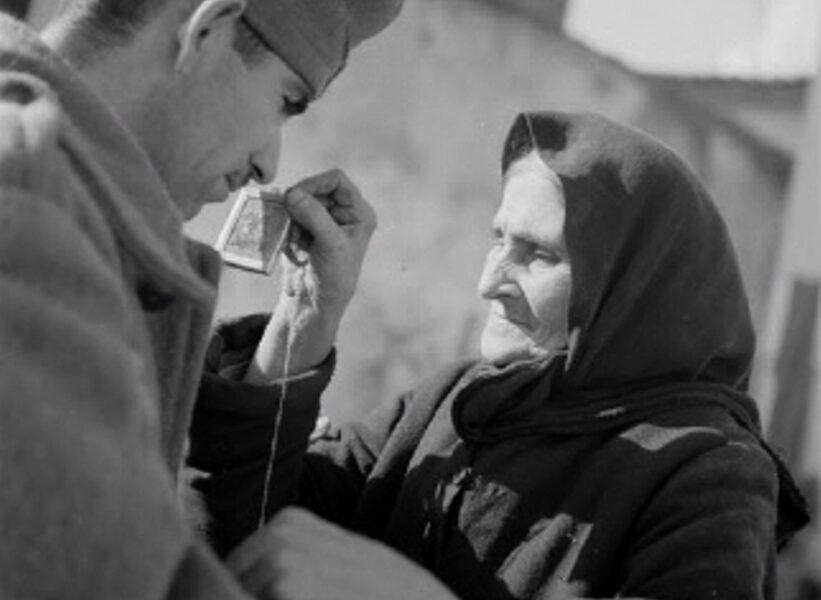
The story behind the featured image of a Greek Mother giving her son what appears like a photo to kiss is a story as old as every bloody war in the history of Greece, where mothers send off their sons with family memorabilia, talismans, and religious items to guard them as they defend their homeland against pirates, barbarians and fascist would-be invaders.
Greece shed much blood fighting for freedom, from ancient city-states to liberation from Ottoman rule, leading to the establishment of modern Greece.
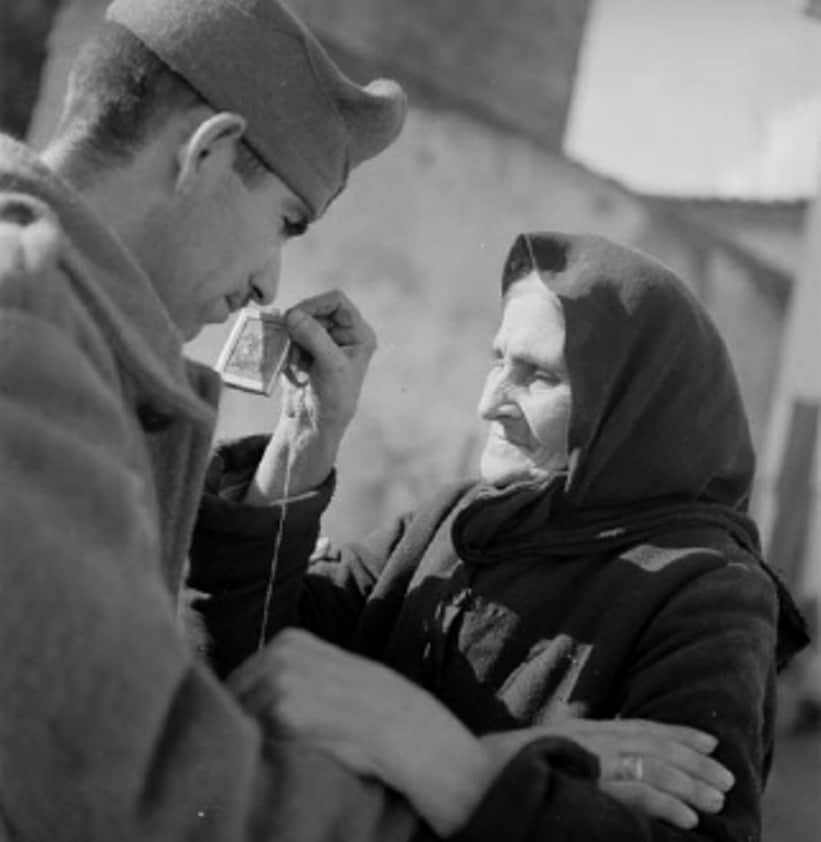
In this photo, infantry soldier Kostas Nikolaou’s mother gives him an icon of St George to kiss a day before the start of the Greco-Italian war as he prepares to head off to the battlefront.
The photo was taken in Athens in 1940 by Voula Papaioannou and from the Benaki Museum Photo Archives.
It is said he offered the following words of consolation to his mother in front of the photographer just as he set off to the battlefront:
Mother, if you see my children, tell them
that the last time you saw me
I was kissing the icon of Saint George.
Don’t cry, mother, you are Greece, mother.
For her I go to fight and I will be victorious mother.
YES, I WILL BE VICTORIOUS!
– Infantry soldier Kostas Nikolaou,
35 years old, killed in battle,
Twenty-seven days after the war started against the Axis Powers.
“Μάνα, όταν δεις τα παιδιά μου, να τους πεις ότι τελευταία φορά με είδες
να φυλάω την εικόνα του Αη Γιώργη.
Μην κλαις ρε μάνα, είσαι η Ελλάδα ρε μάνα.
Γι’ αυτήν πάω να πολεμήσω και θα νικήσω ρε μάνα,
ΝΑΙ, ΘΑ ΝΙΚΗΣΩ!!”
ΣΤΡΑΤΙΩΤΗΣ ΠΕΖΙΚΟΥ ΚΩΝΣΤΑΝΤΙΝΟΣ ΝΙΚΟΛΑΟΥ, ΕΤΩΝ 35
Σκοτώθηκε σε μάχη 27 ημέρες μετά την έναρξη του πολέμου.
Αναφορές λένε ότι σκότωσε 400 Ιταλούς στρατιώτες!
Voula Papaioannou (1898-1990)
Voula Papaioannou was introduced to photography in the mid-1930s, focusing successfully on landscapes, monuments, and archaeological exhibits.
A turning point in her work came with the declaration of the 1940 war, particularly as the suffering of the civilian population in Athens ignited her social consciousness. Realizing that her camera could awaken awareness, she documented soldiers' farewells, the city's preparations for emergency needs, and the care of the first wounded. When famine struck the capital, she condemned the horrors of war through harrowing images of emaciated children.
After Liberation, as head of the photography department of UNRRA (United Nations Relief and Rehabilitation Administration), she travelled through the devastated Greek countryside, capturing the difficult living conditions of its residents. Often straying from her agency's directives, she portrayed personal stories and the faces of ordinary people, reflecting dignity rather than despair.
In the 1950s, she photographed the Greek landscape, monuments, and rural inhabitants. Her work expressed the optimism that prevailed after the war regarding humanity's future, particularly the trend toward the revival of traditional values. During this period, she collaborated systematically with the Greek National Tourism Organization (EOT), founded the Greek Photographic Society (EFE) in 1952, and participated in exhibitions in Greece and abroad.
Voula Papaioannou was part of the "humanitarian photography" movement, which emerged as a response to the erosion of human values caused by war. In 1976, she donated her work to the Benaki Museum.
Χρονια Πολλα
Stay updated with the latest news from Greece and around the world on greekcitytimes.com.
Contact our newsroom to share your updates, stories, photos, or videos. Follow GCT on Google News and Apple News.

