
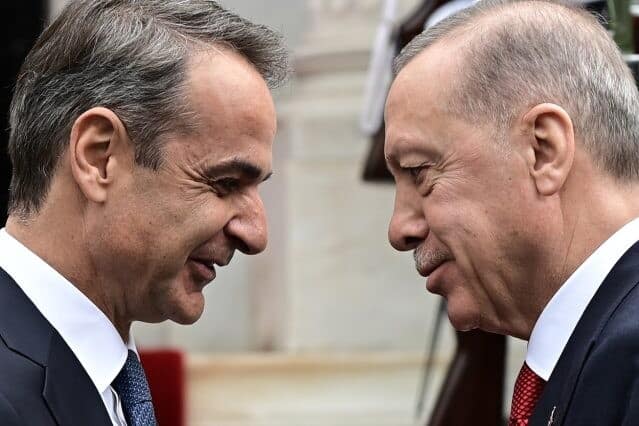
Greek Prime Minister Kyriakos Mitsotakis and Turkish President Recep Tayyip Erdogan are expected to meet during the UN General Assembly in New York (September 22-26) as they attempt to overcome the stagnation in Greek-Turkish relations that has persisted for two and a half years.
Foreign Minister George Gerapetritis confirmed the anticipated meeting in an Action 24 interview, noting such encounters are never ceremonial.
However, the Greek-Turkish agenda faces significant challenges from recent Turkish actions that have heightened Athens’ suspicions. Turkey has blocked the Greece-Cyprus electrical interconnection project (Great Sea Interconnector-GSI) and intensified efforts to convince eastern Libya to ratify the Turkish-Libyan memorandum – a plan Athens views as aimed at isolating Greece in the Eastern Mediterranean.
These circumstances make substantive discussions extremely difficult. Both leaders face the current international situation with considerable skepticism for different reasons. International balances remain highly sensitive, with no Eastern Mediterranean power currently able to pressure situations in any direction. Even Erdogan, who has repeatedly publicized his relationship with US President Donald Trump, is hesitant to take firm positions. This tendency has intensified as the Trump administration appears unlikely to distance itself from Israel, Turkey’s primary regional rival.\
Greek-Turkish relations maintain their independent significance within this broader framework. However, due to regional upheaval, they could eventually become part of a comprehensive Eastern Mediterranean package.
In New York, Mitsotakis will also meet South Korean President Lee Jae Myung, Indian Prime Minister Narendra Modi and Armenian Prime Minister Nikol Pashinyan. On Tuesday, EU High Representative Kaja Kallas reiterated the European position, stating the Turkish-Libyan memorandum “violates the sovereign rights of third states” and “cannot produce legal consequences for third states.”
(Source: Kathimerini)
Stay updated with the latest news from Greece and around the world on greekcitytimes.com.
Contact our newsroom to share your updates, stories, photos, or videos. Follow GCT on Google News and Apple News.
