
Greek Minister of National Economy and Finance Kyriakos Pierrakakis declared that his election as president of the Eurogroup belongs not to an individual or a single government, but to Greece itself — a country, he said, that endured hardship, believed in its future, and moved forward even in the most unfavourable circumstances.
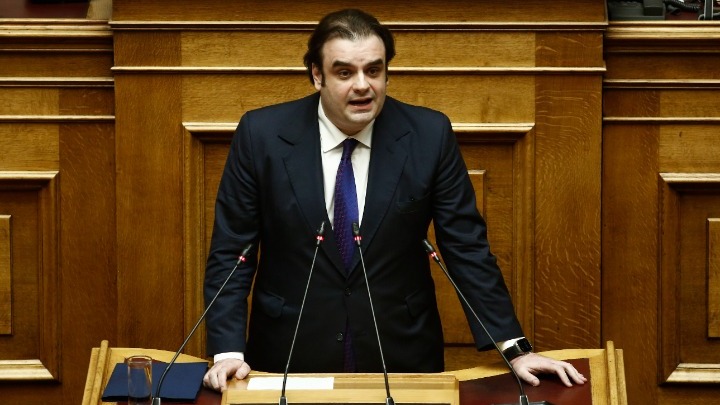
Speaking before the Hellenic Parliament after returning from Brussels, Pierrakakis was met with extended applause from MPs. He characterised his election as “first and foremost a victory for the homeland,” recalling the extraordinary crises Greece faced over the last decade, including the period when its very place in the eurozone was in question. Through reform, determination, and societal resilience, he argued, Greece restored stability and overcame longstanding structural weaknesses.
“Today, Greece is regaining Europe’s trust,” he said, describing that trust as the foundation upon which the country will build its future.
Reflecting on the emotional moments of the Eurogroup vote, Pierrakakis said he was thinking of the many people affected by the crisis — those who suffered, those who stood back up, and those who left the country. He also acknowledged former ministers Kostis Hatzidakis and Christos Staikouras, members of the current economic team, and officials who negotiated through difficult nights during the bailout years. Their work, he said, formed part of yesterday’s victory. “They were not all from one political camp,” he noted.
Pierrakakis emphasised that, in his discussions with eurozone ministers, it became clear the country’s progress is now seen as a reference point in European economic governance. Credibility, he said, is no longer an aspiration but an achievement built through responsibility and persistence. “Greece shapes and contributes to European solutions — something that would have seemed unthinkable only a few years ago.”
Turning to the broader European context, he warned that the EU faces a critical juncture amid geopolitical tensions, energy uncertainty, the digital transition, and the challenge of maintaining social cohesion. Europe, he argued, must act with clarity, ambition, and unity — and Greece has both the experience and the responsibility to contribute.
Pierrakakis then outlined how the 2026 State Budget reflects Greece’s shift from crisis management to sustainable growth. The budget, he said, proves that Greek economic policy can transform restored confidence into a coherent development strategy, social protection, and stable public finances. It is not just a financial plan for 2026 but a vision of where Greece intends to stand by the end of the decade.
He highlighted Greece’s macroeconomic performance, citing a primary surplus of 3.7% in 2025 and 2.8% in 2026, overall government balance forecasts, and projected growth of 2.2% in 2025 and 2.4% in 2026 — nearly double the eurozone average. Investment growth, projected at 10.2% in 2026, is the highest in Europe, though Greece must continue closing the gap with the EU investment average.
Unemployment is expected to fall to 8.6%, the lowest level since 2008, while inflation is forecast to ease to 2.6% in 2025 and 2.2% in 2026. These indicators, he said, reflect a fundamental shift in Greece’s production model toward investment, exports, technology, manufacturing, and high–value-added services.
Pierrakakis also stressed the importance of the government’s recent tax reform, presented by Prime Minister Kyriakos Mitsotakis at the Thessaloniki International Fair, calling it the most significant overhaul since the post-dictatorship era.
He pointed to the digital transformation of the state and tax administration, which has generated financial resources now being channelled back to society. He also highlighted a major wave of public and private investment expected in 2026, supported by a €16.7 billion Public Investment Programme covering transport, digital networks, resilience projects, health, and education.
The minister also underscored the continued decline of public debt, noting its political significance: “We are not passing the bill to the next generation.”
Pierrakakis ended on a message of realism and optimism: Greece still faces challenges, and many citizens continue to struggle, but the path of stability, prudence, and sustained effort is the only way to secure rising incomes, greater opportunities, and a stronger future.
“The 2026 Budget is not the end of the road,” he concluded. “It is the foundation of the next phase — one in which Greece will no longer compare itself to its past, but to the countries leading growth and progress in Europe. A nation with a strong productive base, high employment, low debt, stable institutions, and social cohesion — a country resilient to crises and determined never to repeat the mistakes of the past. That is the path we are charting, and that is the path we will follow with consistency, responsibility, and vision.”
Stay updated with the latest news from Greece and around the world on greekcitytimes.com.
Contact our newsroom to share your updates, stories, photos, or videos. Follow GCT on Google News and Apple News.
