
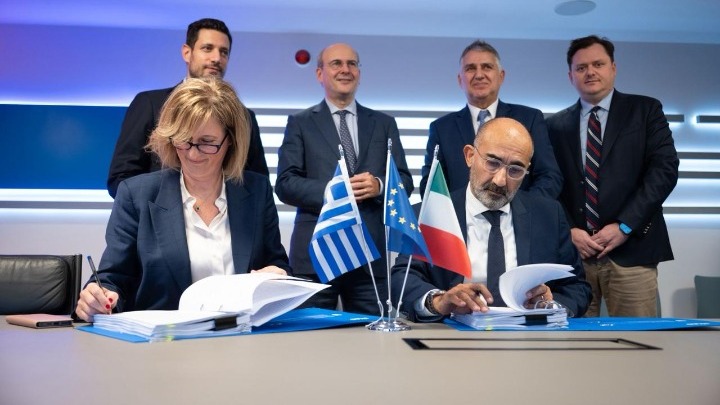
Greece and Italy have cemented a major bilateral agreement to overhaul the Greek railway system, as the Greek government revised its contract with Hellenic Train — owned by Italy’s state rail group Ferrovie dello Stato — securing €420 million in investments, stricter operating rules, and the delivery of 23 new trains by 2027.
According to the Ministry of Infrastructure and Transport, the revised contract provides for €308 million for the purchase of 23 new trains and €112 million for new depots, upgrades, maintenance infrastructure, and digital systems.
For the first time, the agreement introduces a termination clause if the new trains are not delivered to Greece by 2027. It also strengthens penalties in favour of the state for delays, immobilisations, and failures to meet maintenance obligations, while doubling passenger compensation in cases of serious service disruptions.
A new digital geolocation system will monitor train routes in real time, replacing the current paper-based system and establishing a transparent payment mechanism.
“The revised contract locks in €420 million in investments, activates stricter clauses in favor of the state, doubles passenger compensation, tightens fleet maintenance rules, mandates staff safety training, and introduces digital monitoring of services,” the ministry said in a statement.
The agreement builds on a memorandum of cooperation signed on May 12, 2025, in the presence of Greek Prime Minister Kyriakos Mitsotakis and Italian Prime Minister Giorgia Meloni, between the Greek government and Ferrovie dello Stato.
While the memorandum outlined intentions for new train investments financed by the Italian side, months of negotiations followed to ensure binding guarantees. These talks culminated in the revised contract and the official order of 23 new trains from manufacturer Alstom, with deliveries scheduled through 2027.
The government described the move as the largest private investment ever made in Greece’s land transport sector and the first purchase of new trains since before the 2004 Olympic Games.
New Coradia Stream Trains
The fleet renewal will introduce 23 new electric Coradia Stream trains to the Greek rail network, designed for intercity and suburban services.
The trains feature low-floor, step-free boarding, large glass surfaces, adjustable LED lighting, enhanced sound insulation, and dedicated spaces for bicycles, strollers, and large luggage. Each intercity train will offer 335 seats, while suburban units will have 362 seats.
In terms of safety and operations, the trains will fully integrate European ETCS traffic and speed control systems and the TCMS central management system, enabling real-time monitoring and automatic interventions when required.
They will have a maximum speed of 160 km/h, with upgrade potential where infrastructure allows, and up to 10% lower energy consumption. Of the 23 trains, 12 will operate on the Athens–Thessaloniki axis and 11 will strengthen suburban services in Attica and Thessaloniki.
Hellenic Train will fully fund the €308 million cost of the new fleet, as well as an additional €20 million for refurbishing existing rolling stock and €35 million for maintenance infrastructure and systems.
Rail infrastructure works along the Athens–Thessaloniki axis are progressing on schedule and are expected to deliver 100% signalling, remote control, and ETCS automatic braking by summer 2026. Similar systems will be installed on the Thessaloniki–Idomeni section toward the northern border by April 2026.
With these upgrades and the arrival of new trains, travel time between Athens and Thessaloniki is expected to drop to under 3.5 hours.
By 2027, projects are also set to include the Sepolia undergrounding in Athens, upgraded lines in Thessaly, new suburban routes in western Attica and Thessaloniki, extensions toward Patras and the Peloponnese, and the Loutraki–Agioi Theodoroi line.
Priority projects will follow in northern Greece, including the Alexandroupoli–Ormenio corridor. A new vertical rail axis linking Greece with Bulgaria and Romania has also been agreed, aimed at boosting exports and strengthening regional connectivity.
New and Upgraded Stations
The first phase of renovations of Athens and Thessaloniki central stations will begin in early 2026 and conclude by autumn of the same year. Additional tenders will cover suburban stations in Attica and western Thessaloniki, while four new stations will be delivered in the Peloponnese.
With funding from the European Social Climate Fund, 35 more stations nationwide will be upgraded aesthetically and for accessibility for people with disabilities. A second phase of redevelopment for the central stations of Athens, Thessaloniki, and Piraeus is currently at the architectural proposal stage.
From January 1, 2026, a new penalty regime will apply to train immobilisations caused by faults. If more than 10% of annual routes are disrupted — either for at least two consecutive days or five days within a month — the Greek state may terminate the contract.
Penalties of up to €1 million in favor of the state are предусмотрed, alongside increased passenger compensation. The revised contract also introduces, for the first time, doubled compensation for passengers in cases of serious incidents.
If Hellenic Train fails to meet the delivery schedule for the new trains, the state will grant a six-month compliance period before it can permanently terminate the contract and reassign services. Conversely, if infrastructure restoration is delayed, the state will compensate the operator for unfulfilled routes.
Under the agreement, Hellenic Train currently receives €21 million out of a maximum €50 million ceiling, with the remaining €29 million returning to the Greek state to cover network fees and leasing of rolling stock and facilities.
Transparency will be enhanced as compensation and service execution will be calculated based on data from the new geolocation system legislated in July 2025 and implemented by OSE, rather than written reports from the operator.
Deputy Prime Minister Kostis Hatzidakis said Greece is seeking to make “a new start” for its railways by addressing decades-old weaknesses through infrastructure upgrades, advanced safety systems, and new trains.
“This is the first order of brand-new trains in two decades, fully funded by Ferrovie dello Stato, and it sends a clear message that we are determined to build a modern, safe, and European railway that will regain the trust of Greek citizens,” he said.
Deputy Minister of Infrastructure and Transport Konstantinos Kyranakis called the agreement a turning point after six months of negotiations, describing it as the largest foreign investment in land transport in Greece’s history.
“Real change means new infrastructure, new trains, and new stations. This is our plan, and we are implementing it with consistency and determination,” he said, thanking the Italian government and Prime Minister Giorgia Meloni for honoring their commitments.
Stay updated with the latest news from Greece and around the world on greekcitytimes.com.
Contact our newsroom to share your updates, stories, photos, or videos. Follow GCT on Google News and Apple News.
