
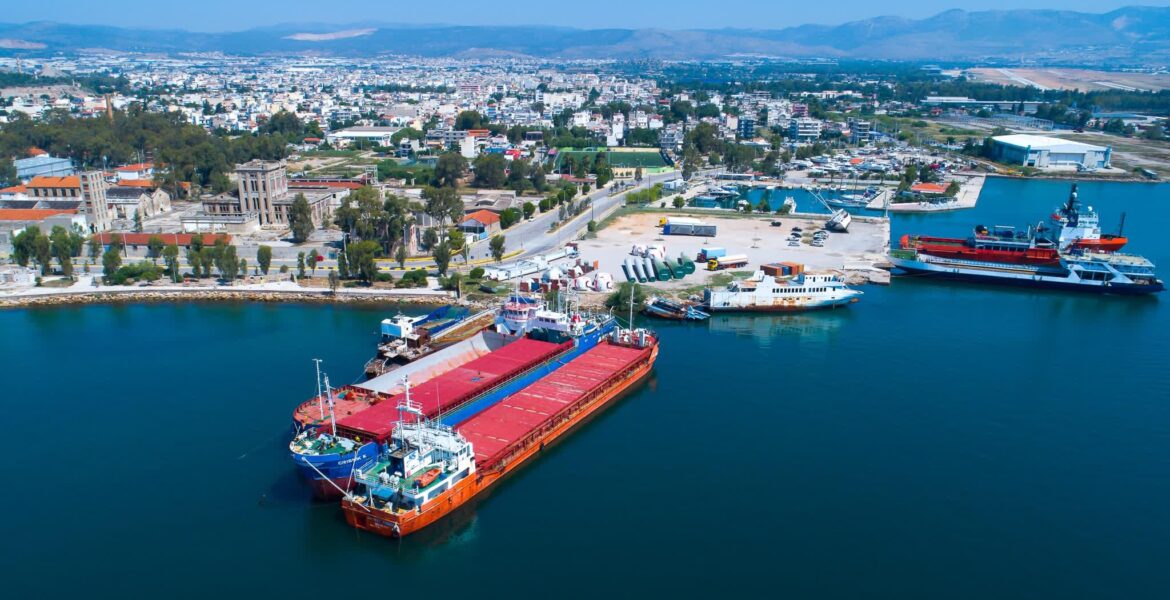
Elefsina, the small port west of Athens with a history dating back to archaic times and whose industrial infrastructure once enjoyed years of glory, has once again found itself in the spotlight, this time amid the geopolitical competition between the US and China.
President Donald Trump, re-elected in 2024 and installed in the White House since January 2025, seeks to limit Chinese influence in critical infrastructure, transforming this ancient city into an alternative cargo hub to the dominant port of Piraeus, which Cosco controls, Bloomberg reports.
The article conveys an accurate picture of Elefsina today, with abandoned factories and rotting ships, elements that remind us that Elefsina once played a leading role in the country's industrial development. Today, the city, sacred site of the Elefsinian Mysteries in antiquity, is overshadowed by the sprawl of Athens and Piraeus - the fifth largest container port in Europe.
The USA-China-Piraeus triangle
Cosco, the Chinese shipping giant, acquired a 67% stake in Piraeus Port Authority in 2016 for 368.5 million euros, taking advantage of the Greek debt crisis. Since then, the port’s revenue has doubled, reaching 231 million euros in 2024, thanks to investments and an increase in cruise ship and ferry arrivals, Bloomberg reports.
Much has changed since the turbulent years of the Greek economic crisis. Washington, seeking to strengthen its presence in Greece through energy projects, views Elefsina as a counterweight to Piraeus. The new US ambassador to Athens, Kimberly Guilfoyle, who took office in November 2025, has called the Chinese takeover of Piraeus “unfortunate” and is promoting American investment in the port.
“I think it’s very important we have so many people interested from the infrastructure perspective to have American infrastructure here to help support the region, to perhaps in fact enhance output from other ports and areas to balance against the Chinese influence with the port of Piraeus. Unfortunately, at that time, as your Prime Minister had mentioned, there were no other bidders,” Guilfoyle said in the interview with Greek ANT1 TV.
The plan envisages the transfer of part of the Elefsina area to a private investor, with a new cargo terminal connected to a rail and road network. The existing port, which currently handles bulk cargo, will be converted into a yacht marina.
These are the American plans that were met with fierce resistance from China. The Asian country's embassy in Athens accused the US of a "Cold War mentality", exploitation of Greece, and an attack on legitimate investments.
"The statements in question, steeped in Cold War mentality and hegemonic thinking, run counter to the fundamental professional ethics of a diplomat and fully reveal the insidious intention of the United States to serve its own geopolitical interests by exploiting the Port of Piraeus and even Greece itself," the Chinese embassy said in a post on social media.
Greece is trying to balance
In the middle, Greece is trying to balance between the two warring sides, Bloomberg notes. Prime Minister Kyriakos Mitsotakis emphasized in a November 2025 interview with Bloomberg: "We respect the agreements of previous governments, but we welcome American capital."
With the economy recovering – exceeding European averages and unemployment falling – the government is attempting to inspire investor confidence, with the Finance Minister elected president of the Eurogroup in December 2025.
However, the plan for Elefsina has a history: in 2023, the US Development Finance Corporation (DFC) lent $125 million to rehabilitate the shipyard there.
The competition will now be open to local and international investors. However, as Bloomberg reports, experts such as Konstantinos Filis, director of ACG Institute of Global Affairs, warn: “Elefsina has advantages, but implementation will take years due to technical and legal obstacles. It will not easily compete with Piraeus.”
The Bloomberg report emphasizes that Greece has been a site of geopolitical conflict in the past, recalling the Allies' intervention after World War II to prevent communist dominance and even to maintain the important American aeronautical base at Souda, Crete.
Just as then, today Greece is called upon to manage a competition between superpowers, this time between the USA and China.
Trump, with policies such as the imposition of tariffs and the recent arrest of the president of Venezuela, is essentially reshaping the world order. At the same time, energy deals are strengthening Athens' ties with Washington: in November 2025, Atlantic Sea (a subsidiary of DEPA) signed a 20-year LNG contract with Venture Global from 2030, while DEPA will supply Ukraine, Bloomberg notes.
Elefsina, a sustainable hub
Beyond all this, the article concludes, Elefsina, the European Capital of Culture in 2023, shows potential for regeneration, but also significant challenges that need to be addressed to become a sustainable hub.
Monocle had described the city as a model for “post-industrial areas”, highlighting its cultural revitalization through exhibitions and festivals that have attracted international attention. However, locals express strong concerns about the already existing congestion.
The city, located on a critical road axis between Athens and Western and Southern Greece, already faces pressure from heavy-vehicle traffic.
The redevelopment requires detailed studies on environmental impacts, noise, pollution and social acceptance, while similar developments are underway in other ports: a private investor is soon to be announced for Lavrio, near Athens, with an emphasis on smaller cargoes and tourism, while Alexandroupolis, in the Northeast Aegean, is being prioritized through an international tender due to its proximity to energy projects such as natural gas pipelines and NATO bases, strengthening its geostrategic position.
Elefsina in the context of strategic development
Economically, the move to Elefsina is fully integrated into the national strategy for the development of port infrastructure, aiming to strengthen logistics, exports, and the competitiveness of the Greek economy at a European level. With investments in new infrastructure – such as the connection to the railway and road networks, the creation of a bulk and general cargo terminal, and the conversion of the existing port into a marina – Greece can increase its cargo capacity without depending exclusively on Piraeus, attracting logistics, shipping, and industrial companies, Bloomberg notes.
Details of the final design, including how to connect to the national transport network, environmental approvals, and measures to reduce impacts on residents, are expected in the coming months through an open tender to local and international investors. Greece, carefully balancing between the US and China, aims for a win-win scenario: respecting existing agreements with Cosco, welcoming American capital, and maximizing economic benefits.
In an era of increasing geo-economic tensions, Elefsina can evolve into a symbol of balanced, sustainable development, provided that the technical, legal, and social challenges are overcome with transparency and dialogue, Bloomberg concludes in its article.
READ MORE: Greece Pushes to Become Southeast Europe Energy Hub.
Stay updated with the latest news from Greece and around the world on greekcitytimes.com.
Contact our newsroom to share your updates, stories, photos, or videos. Follow GCT on Google News and Apple News.
