
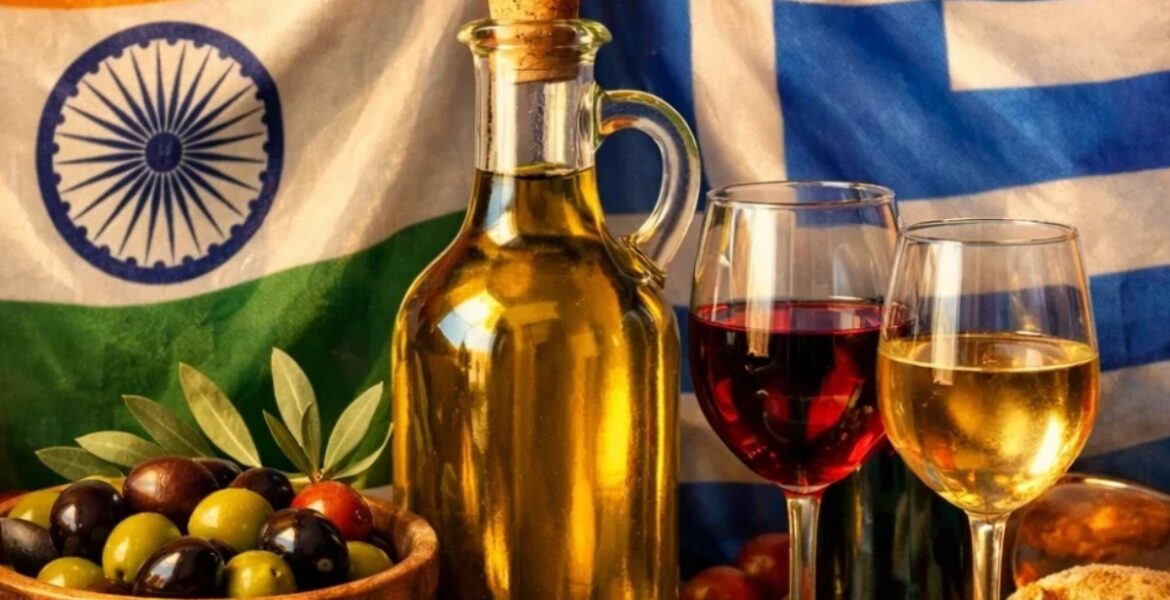
The trade agreement between the European Union and India is not just a technical tariff arrangement. It is a strategic choice that connects two economies and creates a single market of almost two billion consumers.
The agreement provides for the gradual elimination or drastic reduction of tariffs on the vast majority of products traded between the two sides.
The scale of the change is indicated by the extent of Indian tariffs being reduced: on vehicles from 110% to 10%, on wine from 150% to 20%, while on products such as pasta and chocolate – with a current tariff of 50% – the charges are completely abolished.
According to Brussels, the total annual relief for European companies is estimated at 4 billion euros. For countries like Greece, the question is not the size of the reduction, but which sectors are ready to convert the lower tariffs into real exports.
According to the latest available data:
- Greek exports to India were approximately $131.3 million in 2024.
- Imports from India to Greece were approximately $1.15–1.17 billion in 2024.
The result is a trade deficit of almost $1 billion, steadily in favor of India. And that's before the agreement is even fully implemented.
What's changing for Greek exports?
For Greece, the main benefit is simple: lower tariffs mean more competitive prices in the Indian market.
Won sectors:
- Agri-food products (olive oil, olives, wine, processed foods)
- Building materials and marble, with India investing massively in infrastructure
- Chemical and industrial products
- Energy and petroleum products
Until now, high Indian tariffs acted as a deterrent. Many Greek products were simply expensive. That is changing, at least on paper.
Why olive oil wins hands down
To date, Greek olive oil in India has been:
- expensive due to tariffs (high, dissuasive),
- marginal in consumption,
- a product for the few, not for the market.
With the EU-India agreement:
- tariffs are falling drastically or gradually being reduced to zero,
- the final price becomes competitive,
- It opens up space for premium but mass positioning.
It is indicative that in 2024, Greek olive oil exports to the country amounted to just 7.5 tons. The room for growth is enormous. The question is who will exploit it.
What does Greece import from India?
The agreement, however, works both ways. Greece already imports bulk products from India, which with the reduction in tariffs will become even cheaper:
- Pharmaceutical products and active ingredients (APIs)
Critical raw materials for the European and Greek pharmaceutical industry. - Fabrics and ready-made garments
- Chemicals and industrial raw materials, fertilizers, and intermediate products.
- Foods such as rice, tea, and spices.
- Jewelry and processed precious stones, mainly diamonds.
- Low and medium-cost machinery and spare parts.
Diamonds are the "big" winner – but not for Greece
In the EU-India agreement, diamonds are indeed among the big winners:
- India controls over 90% of the world's diamond cutting and processing.
- The tariff reduction makes Indian polished diamonds cheaper in Europe.
- This directly increases imports into the EU.
The balance is clear: India wins, not European – and certainly not Greek – exports.
A post shared by 🇮🇳 Gems & Jewellery Export Import Trainers (@amt.luxury)
Shipping in the background – but at the core
Although not directly reflected in tariffs, Greek shipping is one of the silent beneficiaries. More EU-India trade means:
- more loads,
- increased movement of goods,
- greater demand for transport and logistics.
And here Greece has a clear comparative advantage.
The counterargument: Competition and price pressure
Reducing tariffs on Indian products means:
- cheaper imports to the Greek market,
- more intense competition for domestic producers in specific sectors.
Simply put: what you gain as an exporter, you lose as a protected producer.
The bet for Greece
The EU-India agreement is not a panacea. It is an opportunity, not a guarantee. If Greek businesses do not invest in:
- extroversion,
- branding,
- adaptation to the characteristics of the Indian market,
the greatest benefit will be absorbed by other European economies.
Conclusion
Tariffs are falling and the game is changing. For Greece, the question is not whether the deal is positive. It is who will take advantage of it and who will simply continue to run deficits.
READ MORE: Greece to Spend Over €1 Billion Upgrading F-16 Fighter Jets.
Stay updated with the latest news from Greece and around the world on greekcitytimes.com.
Contact our newsroom to share your updates, stories, photos, or videos. Follow GCT on Google News and Apple News.
