
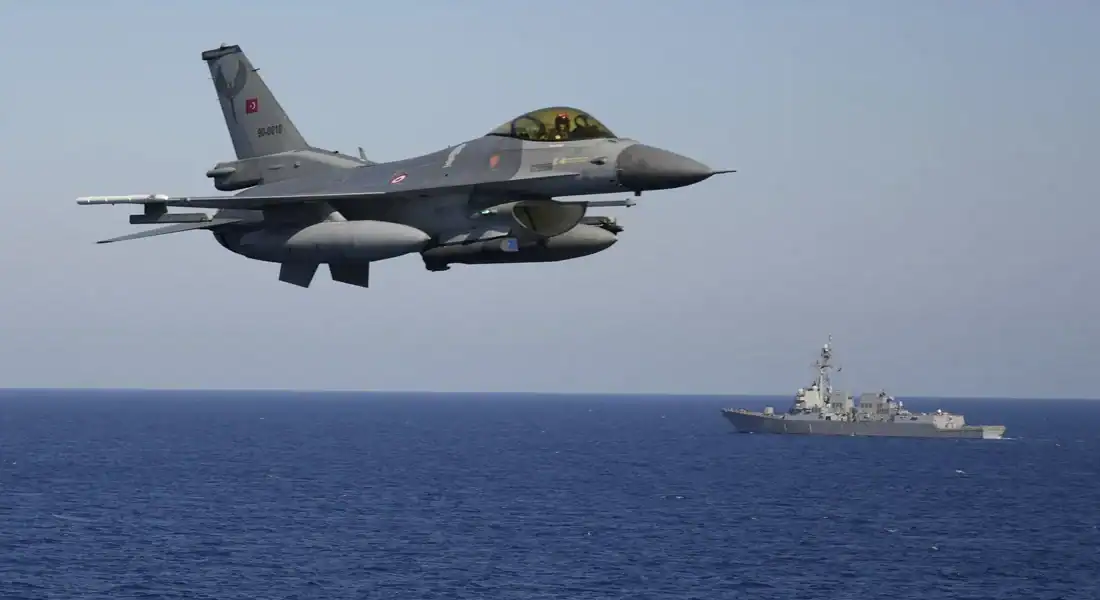
The number of Turkish fighter jets set to deploy in northern Cyprus will increase to six F-16 aircraft, according to officials from the Turkish Cypriot civil aviation authority.
Askin Meseli, acting director of the authority, confirmed that while four F-16 jets were initially expected, the total has now been raised to six. The aircraft are scheduled to arrive early Monday at Ercan Airport (Tymbou) in illegally occupied northern Cyprus.(the self-declared Turkish Republic of Northern Cyprus, recognized only by Ankara)
The deployment comes amid heightened tensions in the Eastern Mediterranean following a regional escalation in the Middle East and a recent drone strike that struck the island last week.
Growing Military Presence Around Cyprus
Since the drone incident, multiple countries have moved military assets closer to Cyprus.
Greece was among the first to respond, sending four F‑16 Fighting Falcon fighter jets to Paphos Air Base. Athens later reinforced its presence with naval forces, including the frigate Kimon, described by Greek Prime Minister Kyriakos Mitsotakis as the “pride of the Greek fleet.”
Soon after, France deployed the frigate FS Languedoc, while its aircraft carrier Charles de Gaulle is reportedly heading toward the region. Mitsotakis is also expected to visit Paphos alongside French President Emmanuel Macron.
Other European nations are also contributing to the buildup. Italy has announced plans to send the frigate ITS Federico Martinengo, while Spain is preparing to deploy the frigate Cristóbal Colón.
Meanwhile, the United Kingdom has sent two AgustaWestland AW159 Wildcat helicopters equipped with anti-drone missiles to the island following the strike on the British base at RAF Akrotiri. The Royal Navy destroyer HMS Dragon is expected to deploy to the region soon, with reports suggesting the aircraft carrier HMS Prince of Wales may also be sent.
Signs of Greek–Turkish Coordination
Despite longstanding tensions between Greece and Turkey, recent developments suggest a degree of coordination regarding Cyprus’ role amid the broader regional crisis.
Following Greece’s deployment of F-16s to Cyprus, Ankara did not issue a formal protest. Instead, Turkish defence ministry spokesman Zeki Akturk announced that a delegation from the Greek air force would visit Turkey as part of what he described as confidence-building measures.
At the same time, a Turkish naval delegation recently visited the United Kingdom ahead of the deployment of HMS Dragon, signaling continued dialogue between NATO allies during the escalating regional situation.
Missile Incident Near Turkey
Tensions further intensified earlier in the week when a ballistic missile fired from Iran was intercepted over southern Turkey.
The missile, shot down by NATO air defences, landed in Turkey’s Hatay Province, near the eastern Mediterranean coast.
Initial speculation suggested the missile may have been targeting Cyprus. However, intelligence and diplomatic sources later indicated the intended target was the Incirlik Air Base, a strategic installation jointly operated by the Turkish and United States air forces.
As military deployments continue to increase around the island, Cyprus is rapidly becoming a central hub for allied naval and air forces monitoring the evolving Middle East conflict.
Stay updated with the latest news from Greece and around the world on greekcitytimes.com.
Contact our newsroom to share your updates, stories, photos, or videos. Follow GCT on Google News and Apple News.
