
Yannis Alexis Zepos is an Ambassador emeritus and a former Secretary General of the Ministry of Foreign Affairs.
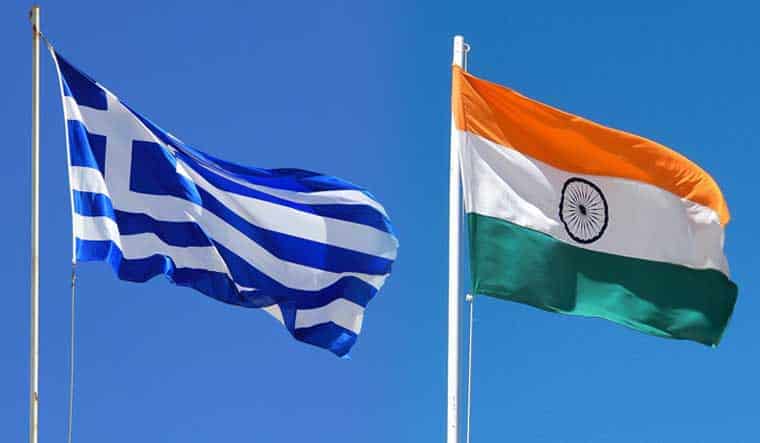
For several years now, perhaps due to my previous service in India as Ambassador of Greece, I have insisted in my speeches and in articles published in the press on the need for our country to examine every possibility of cooperation with India in selective areas of interest to each side.
Greece recently recognized the importance of India, today the largest democracy in the world, not only on the global geopolitical and economic map but especially in expanding and enriching last two years, as has the Indian Prime Minister Mr. Narendra Modi, who has come to our country. This mobility at the highest levels shows that New Delhi has begun to take the Greek reality seriously.
For this reason, and given that the importance of India in our bilateral dimension is now recognized, we proceeded to establish a strategic relationship with this important South Asian country, with a population of 1.5 billion, which currently holds fourth place in the global economic landscape, while it is expected to rise to third by 2030.
And these two states, Greece and India, may not operate on similar or parallel paths, given that they traditionally belong to different geographical and strategic areas, but beyond the economic importance of India for our country, we must take into account the ongoing hostility towards it on the part of Pakistan, which is assisted by our neighboring Turkey, thus increasing the strategic interest of the Indians in Greece and in particular in the field of general military cooperation, co-production of material and joint exercises, which have already begun to show an increasing pace.
Let us not forget that, since Indian independence, we have maintained exceptionally friendly relations with India, which has consistently supported the Cyprus issue in International Organizations. In modern times, both our country and India maintain strong bonds of friendship, partnership, and cooperation with Israel and Cyprus in the Eastern Mediterranean.
In addition, the decision at the G20 level, with the consent of the EU and the US, on the prospect of creating a new multifaceted economic corridor, the IMEC (India-Middle East-Europe Economic Corridor), which will connect the Indian Ocean with the Mediterranean Sea via the Arabian Peninsula and which will end at specific ports in the Mediterranean, is crucial for our country.
And of course, it is still too early to take a position on the difficult and varied phases of the creation of this corridor, because many and arduous geopolitical processes and economic interventions will be needed, but this perspective should hold the interest of Greece, as it already holds the interest of Italy and France, with the timely selection of ports by them that will aim exclusively at the transit trade of India to Western and Central Europe.
However, from our side, a creative interest should also be presented in the port sector, where the Greek side would have every interest in evaluating its participation in this IMEC planning, with the inclusion of a port that will attract the interest of serious Indian players in this sector, such as the Adani Group.
This port, if properly adapted, could become a Greek gateway for Indian products to Eastern Europe.
This development will also highlight the need for broader coordination between ministries and agencies. It will not be the first time that cooperation among multiple agencies has been necessary to address complex problems or achieve ambitious goals.
Regarding economic cooperation between Greece and India, several Indian companies have already entered our country to explore the Greek market, with the most significant presence so far being GMR, which, together with TERNA, has undertaken the construction and operation of the new airport in Kastelli, Crete.
Another sector that should be properly evaluated is that of tourism. With the prospect of direct connections between Greece and India from early 2026, first with the Indian airline Indigo and then, a few months later, with Aegean, this development is expected to seriously affect the number of Indian visitors to our country.
This will mean, first of all, the need to substantially strengthen our embassy and consular authorities in India and the timely commissioning of the new Consulate General of Greece in Mumbai, in order to actively and amicably deal with these new tourist flows, a place where 150 to 200 million Indians currently travel annually outside their country for recreation and visiting relatives.
I left for last the issue of military cooperation, which today seems to be of serious interest to both sides, mainly in the context of cooperation between the Navy and the Air Force. It should be noted that both the Indian and Greek air forces have long used similar French aircraft, such as the Dassault Mirage and Rafale, as well as other types of aircraft, which are traditional sources of supply for both sides.
And while for India the origin of all kinds of military equipment is mainly the former Soviet and current Russian markets, for our country, it is the NATO and American markets, as we know. This does not prevent the frequent holding of joint bilateral, or even expanded, international exercises in Greek airspace, which seem to be in constant development and of interest to both sides.
Similarly, there is a frequent and growing practice of naval exercises by units of the two fleets, Greece and India, in the Aegean and the Eastern Mediterranean, which apparently does not meet the liking of our Turkish neighbors. These exercises are expected to be expanded with the participation of other friendly naval units of countries in the region.
I have tried with this text to provide a current picture of the bilateral relations between Greece and India, as well as their international and bilateral perspectives.
In this picture, it is of particular interest to retain and study, from the Greek perspective, the presented prospects for broader cooperation and synergy in fields of innovation with India, a populous and dynamic, friendly country of the future to us, which recognizes that it shares many historical, cultural, and democratic elements with Greece, ancient and modern.
READ MORE: Greek Prime Minister Pushes for Ukraine Security Guarantees.
Stay updated with the latest news from Greece and around the world on greekcitytimes.com.
Contact our newsroom to share your updates, stories, photos, or videos. Follow GCT on Google News and Apple News.

