
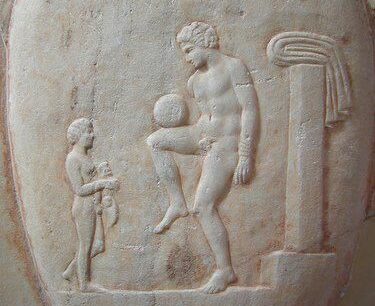
A long, long time ago, before there was football, there were episkyros.
Episkyros (Ἐπίσκυρος) was an ancient Greek ball game. It was highly team-oriented and played with one ball between two teams, each consisting of around 12 to 14 players.
The field was marked with a central white line called the ‘skuros’ dividing the two teams and another white line behind each team to mark the ends of the field.
The game was often quite violent, particularly in Sparta. Each team attempted to throw the ball over the opposing team's head. The objective was to play until one team was forced behind the line at their end, with agility and speed being a player’s most valuable skills.
However, it wasn’t as easy as it sounds. Players had to pass within their own team several times while also evading the defenders from the other team before they could toss the ball over the opponent’s line.
If a team has possession of the ball on its own line, defenders can gang-tackle him back over the line for a point.
A very similar game to episkyros was phaininda (φαινίνδα), which takes its name from Phaenides, who first invented it, or derived from the Greek word ‘phenakiein’ (to deceive) because the players would show the ball to one man but then throw to another, contrary to expectation.
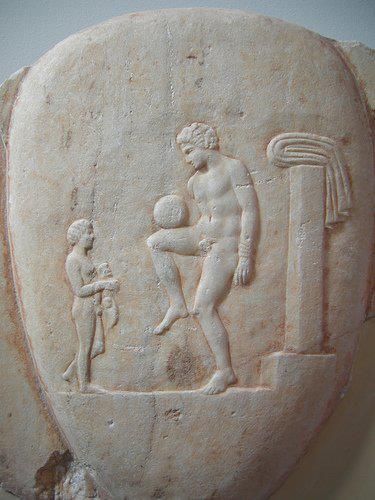
These Greek games of episkyros and phaininda (φαινίνδα) were later adopted by the Romans.
The Romans renamed this game 'harpastum', which comes from the Greek word ‘harpaston’ (ἁρπαστόν), meaning ‘snatched away’, from the verb harpazo (ἁρπάζω)—or to ‘seize’.
FIFA has acknowledged the ancient Greek game of episkyros as an ancient version of modern-day rugby league.
“The Greek ‘Episkyros’ – of which few concrete details survive – was much livelier, as was the Roman ‘Harpastum’,” FIFA.com explains.
“The latter was played out with a smaller ball by two teams on a rectangular field marked by boundary lines and a centre line. The objective was to get the ball over the opposition’s boundary lines, and as players passed it between themselves, trickery was the order of the day.
“The game remained popular for 700-800 years, but, although the Romans took it to Britain with them, the use of feet was so small as to be of consequence scarcely.”
A vase on display at the National Archaeological Museum in Athens depicts a young Greek athlete balancing a ball on his thigh.
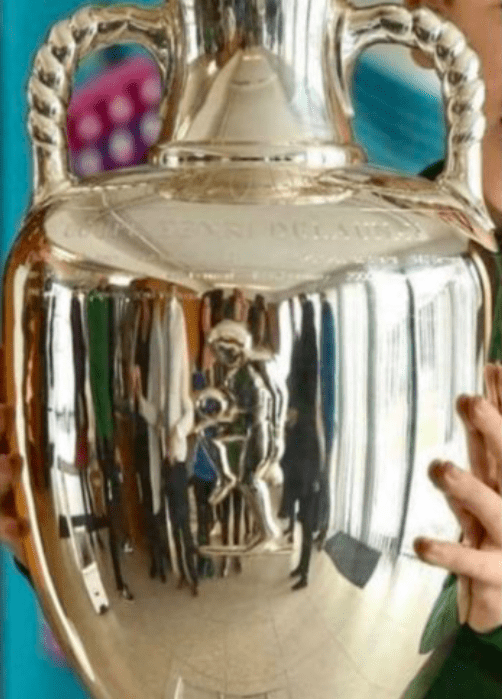
This same vase inspired the design of today’s European Cup football trophy.
Read also:
Facebook has the Ancient Greeks to Thank for its New Name ‘Meta’
Stay updated with the latest news from Greece and around the world on greekcitytimes.com.
Contact our newsroom to share your updates, stories, photos, or videos. Follow GCT on Google News and Apple News.

