
TEHRAN — December 7, 2025
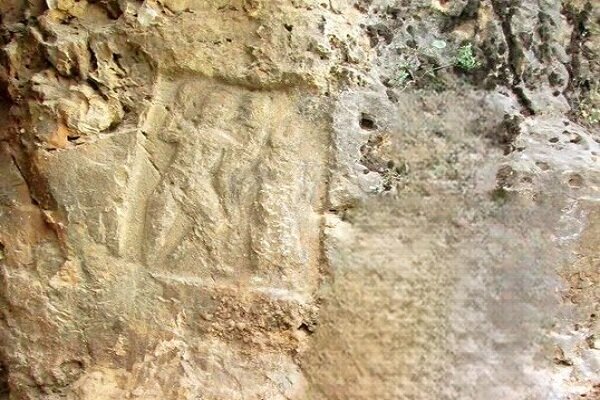
A newly discovered Elymaean rock carving in southwest Iran is attracting significant scholarly attention for its unusual iconography and its possible parallels with the mythological battle between Hercules and the Hydra, a motif widely known from Greek coinage dating to around 325 BC.

The carving was identified in the highlands of Kuh-e Manar in Andika County, Khuzestan Province, an area long recognized as a cultural crossroads within the central Zagros Mountains. Archaeologists believe the relief may offer valuable insight into the religious beliefs, ritual practices, and artistic traditions of the Elymaean civilization, as well as its cultural interactions with neighboring regions.
The discovery was announced by Ayyoub Soltani, director of the Masjed Soleyman Cultural and Industrial Landscape National Base, who described the relief as one of the most distinctive and symbolically rich Elymaean rock carvings identified to date.
Cultural Interaction and Mythological Parallels
According to Soltani, the carving’s imagery and compositional structure suggest it represents a ritual or mythological scene. While deeply rooted in local religious traditions, the relief may also reflect broader Mediterranean influences, highlighting the cultural exchanges that occurred across the Near East during the Hellenistic and Parthian periods.
The scene’s apparent resemblance to the Hercules–Hydra myth—depicted on the reverse of certain Greek coins from the late 4th century BC—raises important questions about cross-cultural transmission of mythological themes. Rather than indicating direct imitation, scholars suggest the Elymaeans may have adapted widely recognized heroic imagery to express indigenous concepts of power, protection, and divine struggle.
Description of the Relief
The carved panel was prepared on an irregular, roughly trapezoidal surface measuring approximately 70 by 81 centimeters. Despite damage from erosion and deliberate defacement, three figures remain discernible.
On the left, a heroic nude male figure is shown in three-quarter profile with pronounced musculature. He raises a large round object—possibly a ritual mace or symbolic weapon—in his right hand, while his left hand grips the throat of the central figure.
The central figure appears as a three-headed serpent-like creature, extending roughly 83 centimeters in length, evoking imagery of chaos or destructive forces commonly seen in ancient mythologies.
On the right, a man dressed in Parthian-style attire stands facing forward. His long, folded garment and rigid posture resemble priestly or ritual figures seen in other Elymaean carvings, suggesting a ceremonial or mediating role within the scene.
Soltani noted that the modeling of the chest, arms, and thighs, along with the careful arrangement of the figures, emphasizes themes of heroism, ritual combat, and divine order.
Elymaean Art and Historical Context
The Elymaeans were direct cultural heirs of the Elamites, carrying forward artistic and religious traditions that later influenced Parthian and Sasanian art. Flourishing from the decline of Achaemenid authority until the early Sasanian period, Elymaean power peaked during the Parthian era, when the region enjoyed relative autonomy.
The growing number of identified Elymaean sites—including rock reliefs, sanctuaries, tombs, and shrines across the Bakhtiari highlands—demonstrates both the extent of their territory and the continuity of their cultural identity. Andika, in particular, is seen as a link between mountainous and lowland ecosystems, facilitating interaction between different Elymaean cultural zones.
Preservation and Future Research
Due to severe erosion and the partial loss of carved details, Soltani emphasized the need for advanced interdisciplinary documentation, including next-generation laser scanning, 3D modeling, and the preparation of accurate moulds.
Protective measures, precise recording, and digital preservation of the site are now considered urgent priorities. Researchers hope that further study will clarify the symbolic meaning of the relief and its place within the broader context of ancient Near Eastern and Mediterranean mythological traditions.
Stay updated with the latest news from Greece and around the world on greekcitytimes.com.
Contact our newsroom to share your updates, stories, photos, or videos. Follow GCT on Google News and Apple News.
