
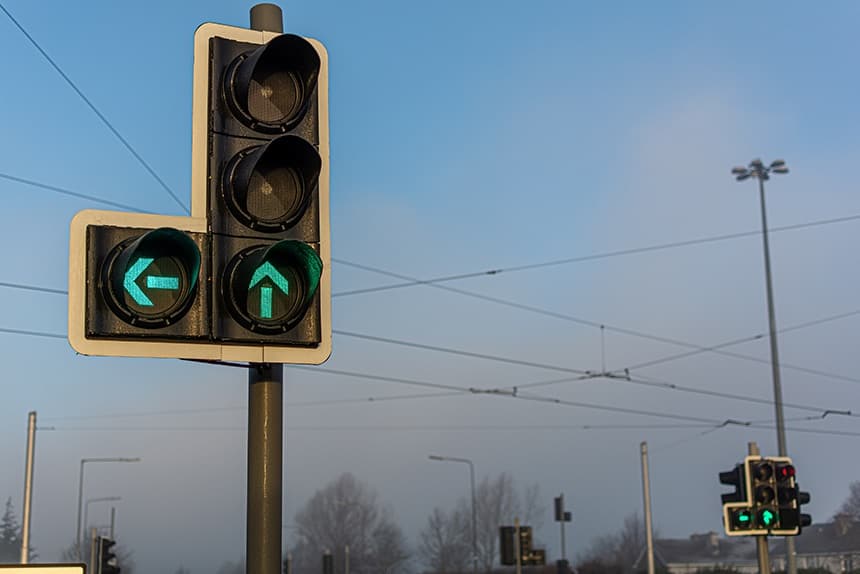
Transport experts are once again urging the adoption of automated, adaptive traffic signal systems—technology that adjusts light timings in real time based on current traffic volume. Such real-time traffic signal systems have been standard in many European countries, including Germany, Spain, and Cyprus, for decades.
In Greece, however, around 50% of traffic lights still operate on fixed cycles, changing regardless of whether roads are busy or empty. Most of the remaining lights follow preset programs with only minimal adjustments, offering little meaningful response to real-time flows. Nationwide, just eight intersections feature truly adaptive controls that respond to actual traffic: seven in the Greater Athens area and one in Thessaloniki.
“We are about 25 to 30 years behind other countries in modernizing our traffic signalization,” said Dimitrios Serbis, head of the transport sector at the Athens Traffic Management Center, in an interview with Kathimerini.
Attica's Congestion Challenge
The Attica region alone has 2,210 signalized intersections, each equipped with anywhere from six to 30 individual lights. According to Serbis, rolling out automated, traffic-responsive regulation on key arteries could reduce average travel times by up to 25%—a significant boost for commuters facing daily gridlock in Athens and surrounding areas.
Previous attempts at modernization were hampered by limited technical expertise, but today the main barrier is funding. While Greece invests heavily in enforcement tools—like expanding AI-powered cameras to detect speeding, red-light running, mobile phone use, and seatbelt violations—dynamic traffic light systems that ease congestion have seen little progress.
This technological gap persists even as road safety initiatives gain momentum, including a new Highway Code, stricter penalties, and plans for thousands of smart enforcement cameras by mid-2026. Yet without real-time adaptive traffic signals, congestion in cities like Athens continues to drain time, fuel, and patience.
Transport specialists emphasize that prioritizing investment in modern signalization—beyond just violation detection—could deliver broader benefits: smoother flows, lower emissions, and fewer delays for residents and visitors alike.
Stay updated with the latest news from Greece and around the world on greekcitytimes.com.
Contact our newsroom to share your updates, stories, photos, or videos. Follow GCT on Google News and Apple News.
