

Saint Valentine, now identified worldwide with Valentine's Day, was a historical figure from the early Christian era during the persecutions under Emperor Claudius II the Goth.
The true story behind the "patron saint of lovers"
Historical sources and legends are unclear, as there are at least two (probably distinct) Saint Valentines who were martyred in the 3rd century: one was a priest in Rome (associated with clandestine marriages), while the other was a bishop in Terni (Interamna), Italy, known for performing healing miracles. Many scholars believe they may be the same person, but this confusion even led the Catholic Church to remove his obligatory feast day in 1969.
The most widespread tradition, however, concerns Valentine of Rome (the priest), whom we associate today with Valentine's Day.
According to Western traditions, Valentine was martyred for performing secret marriages for Christian soldiers—which was forbidden (the emperor believed single men fought better)—and for helping couples unite despite the prohibitions of the time.
A famous legend claims that while in prison, he cured (or fell in love with) the blind daughter of his jailer and sent her a letter signed "from your Valentine"—hence the tradition of love cards.
His memory is honored by the Roman Catholic Church on February 14, a date that gradually became associated with romantic love, especially from the Middle Ages onward, influenced by the English poet Geoffrey Chaucer (in his poem The Parliament of Fowls, birds mate on February 14) and the pagan festival of Lupercalia. Today, it is more of a commercial holiday than a religious one.
How an Aegean island acquired his remains
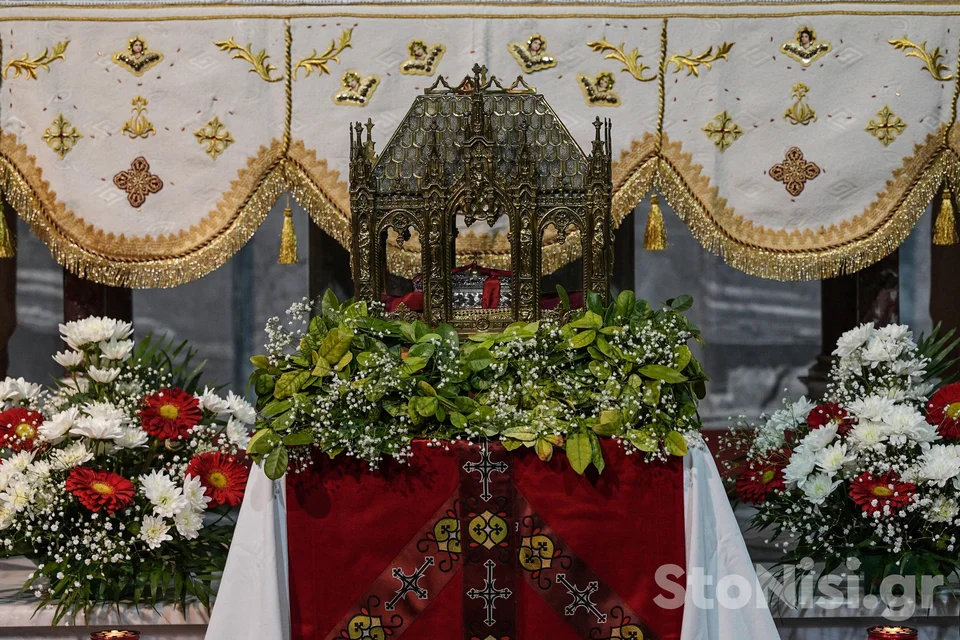
Few people know that Mytilene has a special connection with Saint Valentine. In the Catholic Church of Our Lady (Dormition of the Theotokos) in the city, a portion of his holy relics is kept. These were donated in 1893 by Elisavet Theofanopoulou-Bartzili (or, according to other sources, by Pope Gregory XVI in the 19th century) to the Catholic community of Lesvos.
In 1907, the Catholic Archbishop of Smyrna, Dominikos Marengos, conducted an official inspection and authentication of the relics, which were then placed under the main altar.
Since then, Saint Valentine has been honored every year in Mytilene with liturgies, a procession of the relics through the streets, and pilgrimages. The island has become internationally known as one of the places where his relics are preserved (along with sites in Poland and Italy), and the Catholic community organizes events that attract Orthodox visitors as well.
Who is the “Saint of Lovers” in the Orthodox Church?
The Orthodox Church does not honor Saint Valentine as the patron of lovers and has not adopted the Western tradition of February 14. However, there are saints regarded as protectors of marriage, conjugal love, and family.
- Saints Aquila and Priscilla (February 13)
A couple from the early Church and collaborators of the Apostle Paul. They are considered a model of conjugal love and devotion. - Saints Timothy and Maura (May 3)
A young couple who martyred together, symbolizing unity and faith within marriage. - Saints Peter and Febronia of Murom (July 8)
In the Russian Orthodox tradition, they are regarded as the protectors of family and love. Their feast day in Russia serves as the equivalent of "Valentine's Day." - Saint Hyacinth (July 3)
In some modern Greek parishes (mainly due to initiatives by the Metropolis of Demetrias and in places like Anogeia, Crete), he is honored as the patron of love, romantic couples, and youth—a popular development that emphasizes purity and faithfulness.

Why February 14 became the “Day of Lovers”
Despite its original religious significance as the commemoration of an early Church martyr, Saint Valentine's Day gradually became linked to the romantic custom of exchanging cards, flowers, and gifts.
As mentioned earlier, this evolution began mainly in 14th-century England (influenced by Chaucer's poetry and older pagan fertility traditions) and was later boosted by the commercial greeting-card industry.
Today, Saint Valentine's Day is celebrated worldwide as a symbol of love, romance, and affection—a holiday that transcends religious boundaries and unites people through small acts of tenderness.
Stay updated with the latest news from Greece and around the world on greekcitytimes.com.
Contact our newsroom to share your updates, stories, photos, or videos. Follow GCT on Google News and Apple News.

