

Today, the Greek Orthodox Church remembers the miracle of Saint Theodore the Tyro and Kolyva (boiled wheat).

On the two Saturdays before Lent and the first Saturday of Lent, we celebrate Liturgies in which we commemorate our loved ones who have passed on. Lists of names are brought together with Kolyva.
Fifty years after the death of Saint Theodore, the emperor Julian the Apostate (361-363), wanting to commit an outrage upon the Christians during the first week of Great Lent, commanded the city-commander of Constantinople to sprinkle all the food provisions in the marketplaces with the blood offered to idols. Saint Theodore appeared in a dream to Archbishop Eudoxius, ordering him to inform all the Christians that no one should buy anything at the marketplaces, but rather to eat cooked wheat with honey (Kolyva).
In memory of this occurrence, the Orthodox Church annually celebrates the holy Great Martyr Theodore the Recruit on the first Saturday of Great Lent. On Friday evening, at the Divine Liturgy of the Presanctified Gifts, following the prayer at the ambo, the Canon to the holy Great Martyr Theodore, composed by Saint John of Damascus, is sung. After this, Kolyva is blessed and distributed to the faithful. The celebration of the Great Martyr Theodore on the first Saturday of Great Lent was set by the Patriarch Nectarius of Constantinople (381-397).
The Troparion to Saint Theodore is quite similar to the Troparion for the Prophet Daniel and the Three Holy Youths (December 17, Sunday Before Nativity). The Kontakion to Saint Theodore, who suffered martyrdom by fire, reminds us that he also had faith as his breastplate (see I Thessalonians 5:8).
Saint Theodore the Recruit is also commemorated on February 17.
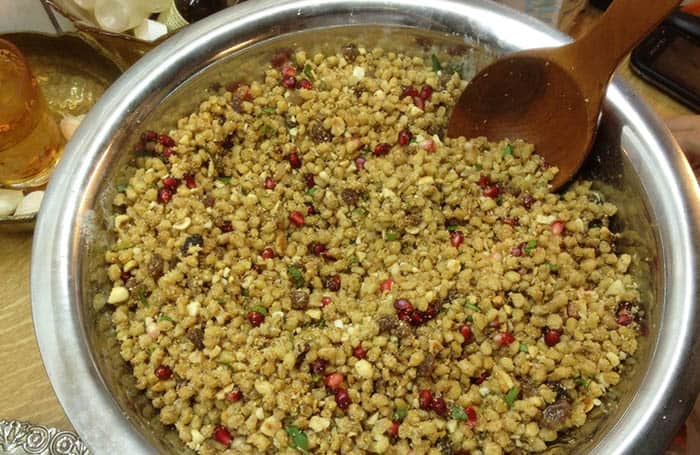
Koliva is boiled wheat with (depending on the recipe) a combination of some or all of the following ingredients: icing sugar, almonds, ground walnuts, sesame seeds, cinnamon, pomegranate seeds, raisins, anise, parsley, and more.
Happy Name Day to everyone celebrating today!
Doris, Dora, Ntora, Theodora, Theodora, Theodora, Dora, Thodoris, Thodorakis, Theo, Theodore.
Χρόνια Πολλά σε όλους και όλες που γιορτάζουν σήμερα!
Δώρης, Δώρα, Ντόρα, Θεοδώρα, Θεοδώρα, Θεόδωρος, Δώρος, Θοδωρής, Θεοδωράκης.
Kolyva Recipe
Kolyva (or Koliva) is a traditional Eastern Orthodox dish made of boiled, sweetened wheat berries, nuts, fruit, and spices, served at memorial services to symbolize the resurrection and eternal life. The key to a successful kolyva is ensuring the wheat is completely dry before mixing to avoid a mushy texture.
Preparation Time: 8-10 hours (soaking) + 1 hour (cooking) + 4-8 hours (drying)
Yields: 1 Large Platter
Ingredients
- 3 cups whole wheat berries (soft winter wheat)
- 1 cup finely chopped walnuts
- 1 cup toasted slivered or chopped almonds
- 1 cup raisins (golden or regular)
- 1 cup pomegranate seeds (arils)
- 1 cup graham cracker crumbs, dry breadcrumbs, or zwieback toast crumbs
- 1 tbsp ground cinnamon
- 1/2 tsp ground cloves
- 1/4 cup fresh parsley, finely chopped (optional, adds freshness)
- 1-2 cups powdered sugar (for covering)
- Optional: 1/2 cup sesame seeds (toasted), Jordan almonds, or silver dragees for decoration
Instructions
1. Prepare the Wheat (Day Before)
- Wash the wheat berries thoroughly in cold water until the water runs clear.
- Soak the wheat in a large pot of water for 8-10 hours or overnight.
- The next day, drain the wheat, rinse it, and boil it in fresh water for 30-60 minutes, until tender but not splitting.
- Drain well, then spread the wheat on a clean baking sheet or tea towel to cool and dry for at least 4 hours or overnight. Do not skip this step.
2. Mix the Ingredients
- In a large bowl, combine the dried, cooled wheat, nuts, raisins, pomegranate seeds, spices, and parsley.
- Add about half of the breadcrumbs or crushed graham crackers to the mixture. This helps absorb any remaining moisture.
3. Assemble and Decorate
- Transfer the mixture to a serving dish and press it down firmly with your hands or parchment paper to create a compact, smooth surface.
- Sprinkle the remaining breadcrumbs over the top to create a barrier for the sugar.
- Sift a thick layer of powdered sugar over the entire surface.
- Decorate the top with a cross in the center using Jordan almonds, raisins, or nuts.
Tips for Success
- Dryness is Key: If the wheat is wet, it will turn into mush and make the sugar melt.
- Decoration: Do not add sugar and decorations until the morning of the service, as they may become damp in the refrigerator.
- Flavor: Some recipes add a touch of anise or orange zest for extra flavor.
Stay updated with the latest news from Greece and around the world on greekcitytimes.com.
Contact our newsroom to share your updates, stories, photos, or videos. Follow GCT on Google News and Apple News.

