
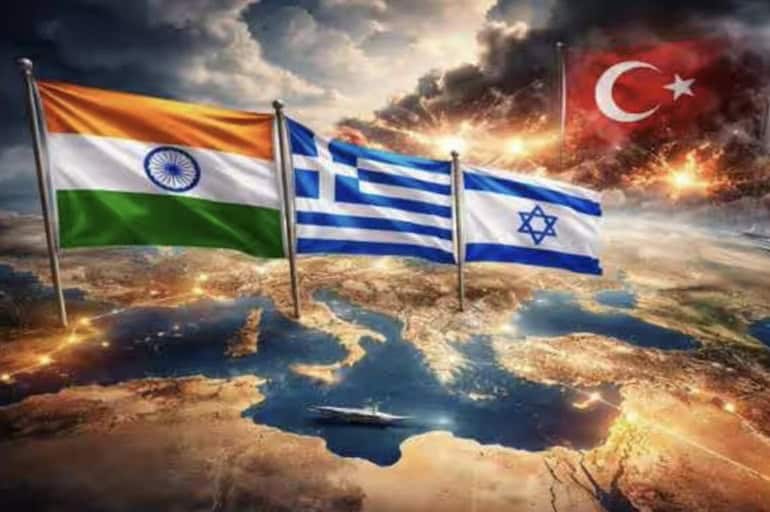
As reported, Ankara is now trying to present itself as a force for stability, while Israel is viewed, in the Turkish perspective, as a factor that escalates crises. The IMEC transport route also remains a focus.
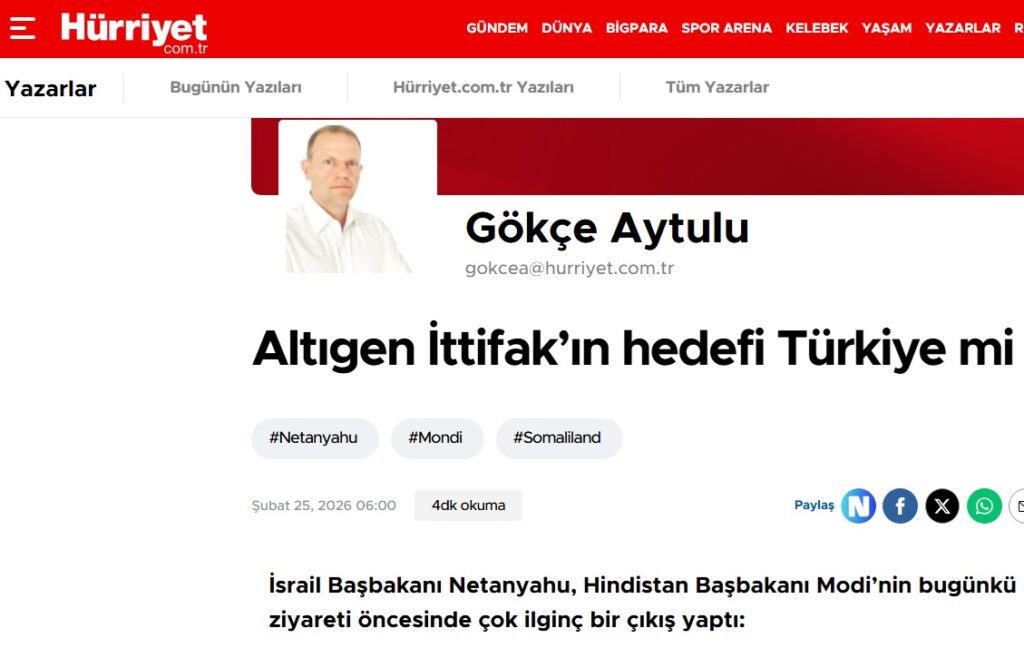
The Turkish newspaper Hürriyet appears fearful, reporting a plan for a "Hexagon of Alliances" extending from the Eastern Mediterranean to the Indian Ocean aimed at Turkey.
The Turkish newspaper blames Benjamin Netanyahu the most, estimating that Turkey is the main geopolitical target behind the new alliance involving Greece, Israel, and India.
In an article by columnist Gökçe Aitulu, on the occasion of the Israeli prime minister's public reference to a "Hexagon of Alliances" shortly before a visit by Indian Prime Minister Narendra Modi, a network of collaborations is described that, as claimed, "ties" from Athens and Nicosia to New Delhi, the United Arab Emirates, Kazakhstan, and the Horn of Africa.
According to the report, Netanyahu publicly describes this security framework as a protection against a "radical Shiite axis" and an emerging "radical Sunni axis."
However, the Turkish columnist points out that the countries mentioned or referenced by the Israeli prime minister, including India, Greece, and the Republic of Cyprus, along with some Arab, African, and Asian nations, do not geographically align with the justification provided, implying that the real enemy he has in mind is Ankara.
Hürriyet places the latest moves toward the rapprochement among India, Greece, and Israel within the same geopolitical context. It references the free trade agreement between the EU and India, the opening of two new Greek trade consulates in India, and Kyriakos Mitsotakis's recent visit to New Delhi, noting that India, now emerging as a global power, has become much closer to Athens and Tel Aviv both economically and militarily.
In the same context, it documents the Modi government's shift away from India's traditionally pro-Palestinian stance, while increasing cooperation in defense, technology, and trade with Israel, a development that has also sparked reactions within the country.
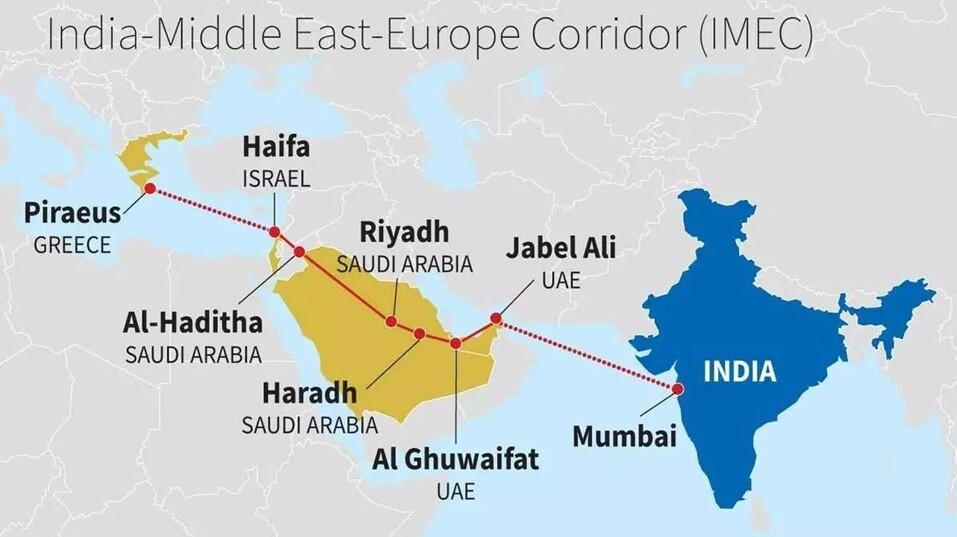
The Turkish newspaper also highlights the central role of the trilateral relationship among Greece, Israel, and the Republic of Cyprus in the Eastern Mediterranean. It recalls the leaders' trilateral meeting in December in Jerusalem, where energy and interconnection projects were connected to the India-Middle East-Europe Economic Corridor (IMEC), and argues that the Greek-Israeli approach involves not only maritime zones but also a broader strategic alignment.
Hürriyet specifically emphasizes cooperation in the defense sector, citing the approval of purchasing 36 Israeli PULS missile launchers worth 650 million euros for Greece, a target of total defense spending of 28 billion euros over ten years, and the training of Greek pilots at a center operated by Israel in Kalamata.
The Turkish newspaper describes Somaliland as an African "piece of the puzzle," noting that its recognition by Israel places it on a collision course with Turkey in the Horn of Africa. Ankara maintains close military and economic ties with Somalia and recently signed a framework agreement on defense and cooperation. It is also preparing to send the drilling ship "Çağrı Bey" to conduct research off the country's coast, a move the newspaper directly links to Israel’s move toward Somaliland.
The United Arab Emirates is highlighted for its role in the Arab link of the "Hexagonal of Alliances" scheme, while Kazakhstan is mentioned in relation to the Asian leg, as it seeks greater independence from Russian influence and aligns itself more closely with the US and Israel.
The article also cites excerpts from an analysis by Seth J. Frantzman in the Jerusalem Post, which states that Turkey's improved relations with regional players after 2019, as well as its involvement in the Russia-Ukraine war, has been a "game changer" in the region.
As reported, Ankara is now trying to present itself as a force for stability, while Israel is allegedly - in the Turkish view - acting as a factor in escalating crises.
In his conclusion, Gökçe Aytülü argues that the rhetoric about the "Hexagonal of Alliances" is essentially Netanyahu's response to the new balances Turkey is shaping, portraying the six-sided alliance as a way to limit its influence from the Eastern Mediterranean to India and Africa.
READ MORE: Dramatic Video: Greek Seafarer Films Missile & Drone Attack on Middle East Port Amid Iran Conflict.
Stay updated with the latest news from Greece and around the world on greekcitytimes.com.
Contact our newsroom to share your updates, stories, photos, or videos. Follow GCT on Google News and Apple News.
