
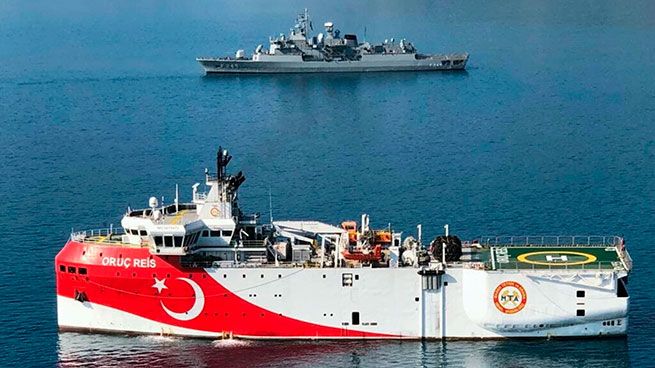
The provocative timing of Turkey's latest maritime assertions has cast a shadow over the otherwise cordial high-level talks in Ankara, where Greek Prime Minister Kyriakos Mitsotakis met Turkish President Recep Tayyip Erdoğan on February 11, 2026, for the 6th Greece-Türkiye High-Level Cooperation Council.
Amid expressions of commitment to dialogue and "positive agenda" cooperation, Ankara's actions—rooted in ongoing claims tied to its controversial maritime deal with Libya—underscore persistent challenges to Greek sovereign rights in the Eastern Mediterranean.
Provocation During the Visit
Turkish Energy Minister Alparslan Bayraktar reportedly highlighted progress on seismic exploration activities in disputed maritime zones south of Crete, areas Athens considers part of its continental shelf. This announcement, aligned with the June 2025 memorandum of understanding (MoU) between Libya's National Oil Corporation (NOC) and Turkey's Turkish Petroleum Corporation (TPAO), came as Mitsotakis was in Ankara holding discussions on normalizing bilateral ties.
The 2025 MoU enables 2D seismic surveys across four offshore blocks in Libyan waters, with at least three reportedly overlapping or encroaching on zones Greece claims south of Crete. The agreement, supported across Libyan factions including those aligned with Khalifa Haftar, builds on the 2019 Turkey-Libya maritime delimitation pact—widely condemned by Greece, Cyprus, Egypt, and others for disregarding island entitlements under the United Nations Convention on the Law of the Sea (UNCLOS).
Bayraktar's direct involvement in publicizing these efforts emphasizes Ankara's dominant role in driving the process, rather than Tripoli taking the lead.
Context of the Ankara Meeting
The visit focused on practical cooperation, yielding several signed agreements on cultural ties, technology, trade, migration management, and earthquake response. Both leaders voiced optimism: Erdoğan described Aegean and Eastern Mediterranean disputes as "complex but not insurmountable" under international law, calling for good-faith dialogue, while Mitsotakis stressed the need to eliminate threats (referencing Turkey's longstanding casus belli over potential Greek territorial waters extension) and highlighted reduced migrant flows in the Aegean due to joint efforts.
No breakthroughs occurred on core issues like continental shelf/EEZ delimitation or airspace. The talks maintained recent momentum in de-escalation since 2023, but the seismic-related statements highlighted the gap between rhetoric and actions.
Greek Perspective and Implications
Athens views these developments as a direct affront to its sovereign rights and yet another Turkish bid to legitimize expansive claims through bilateral pacts with third parties, circumventing multilateral frameworks.
The irony is stark: just as leaders discussed confidence-building and tension reduction, Ankara advanced energy pursuits in contested areas. This echoes past patterns where diplomatic thaws coexist with unilateral moves.
Greece is poised to address the matter urgently at EU level, the United Nations, and other international fora to defend its maritime jurisdictions. The incident may complicate further normalization, despite mutual interest in stability amid shared regional challenges like migration and energy security.
As both sides navigate these tensions, the Eastern Mediterranean remains a flashpoint where energy ambitions, legal interpretations, and geopolitics intersect—testing the durability of the current diplomatic thaw.
Mitsotakis–Erdoğan Meeting Underway in Ankara: High-Level Cooperation Council Convened
Stay updated with the latest news from Greece and around the world on greekcitytimes.com.
Contact our newsroom to share your updates, stories, photos, or videos. Follow GCT on Google News and Apple News.
