

The United States economy surged in late 2025, posting its strongest growth in two years,…
Tag: unemployment

The average full-time salary in Greece’s private sector exceeded €1,500 in 2025, reaching €1,516, a…

Greece created more than 563,000 new jobs between December 2019 and December 2025, while full-time…

Greece recorded its second-best unemployment performance in the past 22 years in December, with the…

Greece’s unemployment rate fell to 8.2% in November 2025, marking a significant improvement compared with…

Greece is entering 2026 as a “year of opportunities,” with economic growth, investment and citizens…

The International Monetary Fund (IMF) has projected that the Greek economy will grow by 2%…
Greece’s unemployment rate dropped to 8.6% in Q2 2025, down from 10.4% in Q1 2025 and 9.8% in Q2 2024, with July 2025 at 8%. The number of unemployed fell to 411,722, a 15.7% decrease from the previous quarter, while employment rose to 4,386,832, up 4.0%.
Despite recent wage hikes, Greece lags far behind the EU average, with salaries rising only 7% from 2018 to 2023 compared to the EU’s 19%, according to a new KEPE study. With an average annual salary of €17,000, Greece ranks third from the bottom among EU nations, highlighting a stark divide between northern and southern Europe. Stagnant productivity and declining real wages have widened income inequality, with profits now claiming 50.2% of Greece’s GDP, far above the EU’s 41%.

Nearly one in three Greek workers cannot afford even a small weekly personal expense, according to a new report by the Labour Institute of GSEE. Despite being employed, a significant share of Greece’s workforce lives in poverty—placing the country second in the EU for rates of working poor and highlighting deepening economic hardship and social deprivation.

Greece’s unemployment rate dropped to 8.3% in April 2025, down from 10.8% a year earlier, according to ELSTAT. The number of unemployed fell by 128,525, with women’s unemployment at 10.8% and men’s at 6.3%. Youth unemployment (15-24) also declined to 20.4%, signaling a strengthening labor market.

Cyprus’ labor market is showing its strongest performance since the global financial crisis, with unemployment…

Greece’s economy is set to continue outpacing the eurozone average, with the European Commission forecasting steady GDP growth of 2.3% in 2025 and 2.2% in 2026. Driven by strong consumption and EU-funded investment, the country also sees declining unemployment and falling public debt, despite global economic uncertainties.

Greek Prime Minister Kyriakos Mitsotakis outlined 15 key employment reforms, highlighting record job creation, a rising minimum wage, and new worker protections, while setting ambitious targets for wage growth and labour rights by 2027.

Prime Minister Kyriakos Mitsotakis welcomed the temporary suspension of U.S. tariffs and urged the EU to pursue a zero-tariff trade deal with Washington. During visits to industrial hubs in Central Greece, he highlighted government support for manufacturing, rising wages, and record-breaking investments aimed at boosting exports and reducing unemployment.

Prime Minister Kyriakos Mitsotakis addressed recent protests and the Tempi train tragedy, stating, “The majority demanded truth, justice, and modern trains—we must move faster to reform the state. This majority will judge us in 2027.” Alongside political reflections, he highlighted economic growth (2.3% in 2024), a 17-year low unemployment rate (8.7%), and new initiatives in health, housing, tourism, and energy exploration.
Greece has emerged as a global economic leader, joining Spain and Italy among the top five performers in 2024, according to The Economist. This marks the Mediterranean region’s continued ascent in economic prominence, with Greece’s GDP growth, share prices, and reduced unemployment contributing to its high ranking.

The Greek economy is set to grow by over 2% annually through 2026, fueled by EU funds and employment gains, according to an OECD report. While highlighting Greece’s recovery from its debt crisis, the OECD urged further reforms to enhance investment, competitiveness, and tax policy. Prime Minister Kyriakos Mitsotakis emphasised the nation’s progress in job creation and rising wages, while pledging continued reforms under Greece’s stable government.
Greece’s unemployment rate fell to 9.8% in October 2024, down from 10.8% a year earlier but up slightly from September. While employment rose, concerns remain about high youth and long-term unemployment.

Greece’s economy is set for robust growth, outpacing the Eurozone and EU averages through 2026, according to the latest European Commission forecast. With GDP growth projected at 2.1% in 2024, 2.3% in 2025, and 2.2% in 2026, Greece’s economic expansion is supported by the Recovery and Resilience Plan. Additionally, inflation is expected to decline, and the public debt-to-GDP ratio is set to decrease to 140% by 2026.
Greece reported a primary budget surplus of €13.489 billion for the first ten months of 2024, far exceeding the €4.667 billion target. This performance was boosted by the early collection of €3.241 billion from the Attiki Odos concession contract. The European Commission projects robust GDP growth for Greece, outpacing EU and Eurozone averages through 2026, alongside declining inflation, unemployment, and public debt levels.
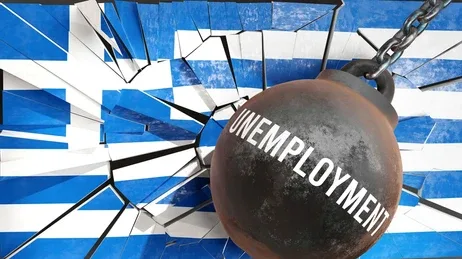
In 2023, the EU reached a historic low in unemployment, with the overall rate for individuals aged 15-74 dropping to 6.1%. However, Greece faced higher-than-average challenges, recording the highest long-term unemployment rate in the EU at 6.2%, as well as a notable youth unemployment rate of 9.8%. While countries like Denmark and Czechia saw much lower unemployment levels, Greece continues to struggle with integrating young people and long-term jobless individuals into the workforce.

In 2023, Greece reported one of the EU’s highest levels of labor market slack at 16.3%, reflecting significant untapped workforce potential. Across the EU, 12% of the extended labor force—over 27 million people—remained underutilised due to unemployment, underemployment, or other factors, with Spain, Italy, and Sweden also showing high slack rates. This data underscores ongoing challenges in optimising labour resources across member states.
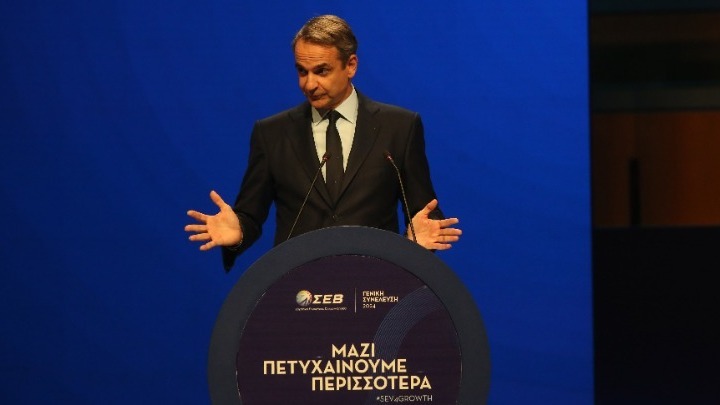
Greek Prime Minister Kyriakos Mitsotakis urged businesses to translate their growth into improved wages and working conditions, highlighting Greece’s significant economic recovery since 2019. Speaking at the Hellenic Federation of Enterprises, Mitsotakis noted Greece’s return to investment-grade status, record tourism, and export growth. He called for reinvesting profits in modernisation, research, and innovation, stressing that economic success should directly benefit employees.

The real income of Italian households is still falling, the gap with the EU is widening: higher only than Greece,” says Corriere della Sera. “Only Greece is worse than us,” reports La Repubblica.

In 2023, Greece recorded one of the lowest employment rates for recent graduates in the EU, with only 72.3% securing jobs. This figure is well below the EU average of 83.5%, highlighting ongoing challenges in the Greek labor market for young professionals.

Between 2010 and 2021, about 600,000 educated Greeks left the country, prompting the finance ministry to offer tax incentives to encourage their return. Despite these efforts, emigration continues, though at a reduced rate. The Greek government, under Prime Minister Kyriakos Mitsotakis, is working to reverse this trend by offering a 50 percent tax rebate for returning expatriates. However, challenges remain, including low living standards and high unemployment, which make it difficult for many to return.

The European Commission’s latest report confirms Greece’s ability to service its debt, noting strong economic growth and fiscal improvements. GDP growth surpassed the EU average in 2023, with further growth expected. Inflation and unemployment are set to decline, while the banking sector remains profitable. The government is advancing privatization and improving state-owned enterprises’ flexibility. Greece’s debt sustainability is considered low risk, supported by a substantial cash buffer and market access.

The employment rate in Greece saw a notable increase of 0.9 percentage points in the first quarter of 2024, contributing to the overall EU employment rate of 75.7%. This rise highlights Greece’s improving job market amidst a generally stable EU labour market, as reported by Eurostat.

Prime Minister Kyriakos Mitsotakis convened a meeting of Greece’s new Cabinet at the Maximos Mansion, emphasizing a dynamic restart after recent elections. He outlined priorities including tackling price hikes, improving public services, and driving reforms to build a stronger Greece by 2027. Mitsotakis also addressed upcoming European challenges and the importance of effective coordination among Ministries and MEPs.
